
Polkadot price outlook: how Referendum 1890 could move DOT

AI Sentiment: 42/100 Bearish
This score is generated through AI-driven analysis of the article's content.

powered by

Buy DOT if it holds $1.18–$1.24 into the May 31 enforcement window. The article points to a potential validator “rebalance” that can be orderly if most operators meet the 10,000 DOT self-stake rule, which should reduce panic selling and keep DOT consolidating above support.
Key Risk: Too many validators fail the new self-stake threshold, forcing broad open-market DOT selling and breaking $1.18 support.
Sell DOT on strength toward $1.24–$1.25 if price fails to build above that zone. The setup is a transition where some operators must buy/rebalance quickly, but the article flags temporary selling pressure as the main near-term driver; rallies into resistance are likely to be sold as compliance approaches.
Key Risk: Validators adjust without selling (or buying is absorbed by demand), and DOT re-rates upward, holding above $1.25.
- DOT trades near $1.24 as markets wait for staking changes.
- 10,000 DOT validator rule may trigger short-term selling pressure.
- If Polkadot's price drops below $1.24, it could test the support at $1.18.
Polkadot DOT has been trading in a narrow and uncertain range, with recent price action showing DOT hovering around $1.24 to $1.25, after a 1% decline over the past 24 hours.
At the centre of attention is Referendum 1890, a governance proposal under Polkadot’s OpenGov system that is set to reshape validator economics.
Validator rules take centre stage ahead of May 31 upgrade
Referendum 1890 introduces a mandatory requirement for validators to hold a minimum self-stake of 10,000 DOT.
At the current price of about $1.24 per DOT, this translates to roughly $12,400 per validator in locked capital.
The rule is designed to ensure that validators carry meaningful financial exposure to their own performance.
This change forms part of a wider staking redesign that aims to improve network security and simplify staking mechanics.
One of the planned downstream effects is the introduction of “unslashing” protections for nominators, reducing the direct risk that smaller stakers face when validators misbehave.
Another expected shift is a reduction in unbonding time, moving from the current extended waiting period of roughly 28 days to a much shorter window of around 24-48 hours.
Market focus shifts to validator behaviour ahead of enforcement
The coming weeks place Polkadot in a transition phase where governance decisions and market liquidity conditions are moving in opposite directions.
In the short term, the main driver of Polkadot’s price movement is expected to remain the validator transition process tied to Referendum 1890.
Some operators who do not meet the new threshold may need to acquire DOT or rebalance positions quickly before the enforcement deadline set around May 31, 2026, creating the possibility of temporary selling pressure.
The key uncertainty is how many validators will need to adjust positions before the deadline and whether those adjustments will require open-market selling of DOT.
A successful and orderly transition could shift attention back toward the longer-term benefits of the staking redesign, including improved staking efficiency and faster capital mobility.
However, if there are more operators who will need to buy DOT coins or rebalance positions, then the price could fall below $1.24 as short-term supply pressure is outweighing governance-driven optimism.
If that happens, then traders can set their eyes on the next support level at $1.18, where prior accumulation was observed.
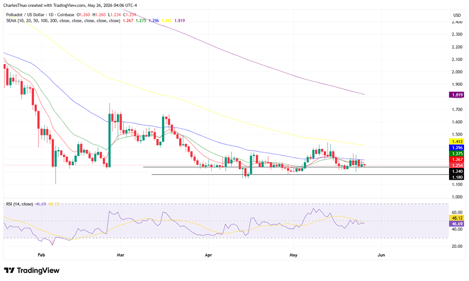
But if a majority of the operators meet the new threshold, then the transition may not impact the market as much, and DOT could hold above the $1.24 support zone and continue to consolidate as participants wait for clarity on validator compliance.

Pi stabilizes near $0.089 as bulls target a return above $0.10

Bitcoin SV gets rejected at $15.39: was this breakout already a trap?

Dogecoin’s whale buying is rising fast: can DOGE reclaim $0.07 next?

Ethereum whales are buying again, so why can’t ETH break above $2,000?

XRP is testing $1 while whales buy, but the charts still look dangerous
No results found
Loading articles...
Failed to load articles. Please try again.