
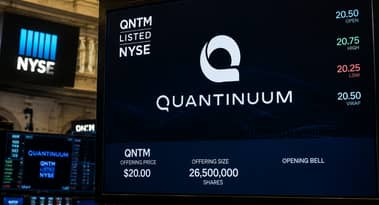
Quantinuum opens 13% above IPO price, valuing quantum computing firm at $17.6B
AI Sentiment: 72/100 Bullish
This score is generated through AI-driven analysis of the article's content.

powered by

Buy QTM. The IPO priced up and opened 13% above offer, signaling real demand for “credible, full-stack” quantum exposure. It also has named enterprise customers (JPMorgan, Amgen) and a clear US government funding tailwind (expected $100M) that can de-risk trapped-ion development and improve follow-on financing odds. Thesis: the market is rewarding the first scalable, government-validated quantum platform, not just hype.
Key Risk: Quantum hardware still can’t produce commercially useful results fast enough, forcing dilution or a funding crunch despite the IPO pop.
Sell the quantum “pure-play” software/consulting names that trade on the same narrative but lack hardware credibility and government backing. If QTM captures the sector’s attention and capital as the “full-stack” leader, weaker players will see multiple compression even if the industry story stays intact. Thesis: capital rotates toward the most fundable, validated platform after a high-profile IPO.
Key Risk: Those peers secure major contracts or partnerships that prove they can monetize without needing hardware breakthroughs, preventing valuation compression.
- Quantinuum shares opened at $68, 13% above their $60 IPO price after raising $1.68 billion.
- The quantum computing company debuted with a market capitalization of about $17.6 billion.
- Despite strong investor demand, the firm reported declining revenue and widening losses in its latest quarter.
Quantinuum made a strong debut on the Nasdaq on Thursday, with shares opening at $68 apiece, 13% above their initial public offering price, in what investors viewed as a significant vote of confidence for the emerging quantum computing industry.
The company raised $1.68 billion in an upsized offering after pricing shares at $60 each, above its previously marketed range of $53 to $55.
At its opening trade price, Quantinuum was valued at roughly $17.6 billion.
The debut marks one of the most closely watched public listings in the quantum computing sector, an industry that has long promised transformative advances in computing power but has struggled to prove commercial viability.
A traditional route to public markets
Founded in 2021 through the merger of Honeywell's quantum computing division and UK-based Cambridge Quantum, Quantinuum positions itself as a full-stack quantum computing platform that provides both hardware and software solutions.
Unlike several other quantum-computing companies that reached public markets through mergers with special-purpose acquisition companies, Quantinuum opted for a traditional IPO process.
Chief Executive Rajeeb Hazra said the decision reflected the company's desire to build credibility in a sector where investors continue to scrutinize technological claims and commercial prospects.
The traditional listing route was chosen, he said, because Quantinuum wanted to demonstrate that there was "no air gap between what we're saying and what we're doing."
The company's successful offering also reflects growing investor willingness to back businesses developing next-generation computing technologies.
"You're starting to see real revenue that's coming from these companies, so it makes sense for them to start to go public," Willy Lee, a principal at SuRo Capital, told MarketWatch.
Commercial adoption remains in early stages
According to its regulatory filings, Quantinuum serves customers across industries including pharmaceuticals, materials science, finance, government, and industrial markets.
Its customer roster includes companies such as JPMorgan Chase and Amgen.
"We have customers today that are using our commercially available hardware and software, our full stack, to get started with their quantum journey," Hazra said in an interview with CNBC on Thursday.
Quantum computing relies on the principles of quantum mechanics to process information in ways that could eventually solve problems beyond the reach of conventional computers.
While practical adoption remains at an early stage, Hazra said demand for advanced computing resources is expected to grow significantly in the coming years.
He described the need for quantum computing capabilities as "absolutely a given," even though widespread commercial deployment is still developing.
Government support boosts industry outlook
The sector received a boost last month when the US Department of Commerce announced preliminary agreements to provide $2 billion in funding and take equity stakes in nine companies involved in the country's quantum ecosystem.
Quantinuum is expected to receive $100 million under the initiative, which is funded through the 2022 Chips and Science Act.
"It’s a great validation of quantum, of Quantinuum, as a strategic asset for the US quantum industry," Hazra said, adding that the support would help advance trapped-ion quantum computing technology.
Financial challenges remain
Despite strong investor enthusiasm, Quantinuum's financial results underscore the challenges facing many companies in the emerging technology sector.
The company reported that first-quarter revenue fell 73% year over year to $5.24 million from $19.1 million.
Net losses widened sharply to $136.5 million from $30.5 million in the same period a year earlier.
Honeywell is expected to retain a majority stake following the IPO and will continue to serve as both a strategic customer and partner, according to the company's prospectus.
For investors, the listing represents a high-profile test of whether public markets are prepared to back quantum computing companies despite ongoing losses and long development timelines.
Thursday's debut suggests that, for now, enthusiasm for the technology remains strong.

Shein’s IPO has a $3.5B catch: why old investors are getting paid first

Unitree stock surged 629% on debut: is China’s robot boom already overvalued?

Anthropic’s reported $2T IPO would eclipse SpaceX’s — but why is it the riskier bet?

Shein’s Hong Kong IPO is finally coming, but at a much lower valuation

DeepSeek eyes new funding round at around $70B valuation
No results found
Loading articles...
Failed to load articles. Please try again.