
Lloyds share price nears pivotal level: is the 3.64% dividend yield worth it?

AI Sentiment: 68/100 Bullish
This score is generated through AI-driven analysis of the article's content.

powered by

Buy LLOY. Dividend yield ~3.65% plus improving fundamentals: net interest income up, underlying profit +31%, and management is still returning cash via dividends/buybacks. Rising gilt yields (10Y ~4.9%) should keep lifting net interest income. Technicals back it: price is supported near the 100-day EMA and sitting on a key Murrey pivot; a rebound toward ~106.26p is the near-term setup.
Key Risk: A sharp UK credit shock (rising loan losses) that overwhelms higher interest income and forces dividend/buyback cuts.
Buy UK bank exposure via iShares UK Financials ETF (LSE: IUKF) or a basket of UK banks, because the news points to a sustained tailwind from higher UK bond yields boosting net interest income across the sector. The second catalyst is capital return: if banks keep improving profitability, buybacks can keep EPS rising even while the economy is weak.
Key Risk: Bond yields fall quickly or the BoE turns dovish, shrinking net interest income and stopping capital returns.
- Lloyds stock price has remained inside a narrow range this year.
- The company has a dividend yield of 3.64% and is repurchasing its shares.
- Lloyds will likely benefit from the elevated interest rates in the UK.
Lloyds Bank (LON: LLOY) share price has moved sideways this year as concerns about its growth and the British economy have remained. It was trading at 100.50p on Friday, inside the range it has remained at in the past few months. So, is it a good stock to buy for investors as its dividend yield remains at 3.65%.
Lloyds Bank’s business is doing well despite the weak UK economy
The UK economy has weakened in the past few years, with key industries like manufacturing being under intense pressure. The unemployment rate has remained above 5%, while inflation has remained at an elevated level in this period.
Most notably, the UK has missed the ongoing artificial intelligence hype, with only a handful of companies being recognized globally. Also, its public debt has continued to surge, and the political crisis is escalating. In a statement this week, Andy Burnham said that he would challenge Keir Starmer as the prime minister.
Still, despite all these challenges, Lloyds Bank’s business has been relatively stable in the past few years, helped, in part, by the higher interest rates. The Bank of England (BoE) has maintained a 3.75% interest rate, and officials have hinted that they may hike this year if inflation remains at an elevated level.
The most recent results showed that its net interest income rose to £3.56 billion in the first quarter from £3.29 billion in the same period last year. Its other income rose by 11% to £1.6 billion, bringing its net income to £4.78 billion.
Most notably, its profitability continued to soar during the quarter. Its underlying profit jumped by 31% to £2 billion, while the statutory profit after tax rose by 37% to £1.5 billion.
These numbers will likely continue improving as UK bond yields rise. Data shows that the ten-year Gilt yield stands at 4.90%, much higher than the year-to-date low of 4.223%. The two-year yield rose to 4.3%.
At the same time, there are signs that the company has concluded handling the motor vehicle insurance issue that drained billions from its books.
Lloyds Bank continues to return cash to investors through dividends and share buybacks. For one, it continues to progressively move its CET1 ratio to 13% from the current 13.4%. This figure has been moving downwards in the past few quarters.
The company is also continuing to reduce the number of shares in circulation by repurchasing stocks worth up to 1.75 billion pounds. Share repurchases aim at boosting the EPS by reducing those in circulation.
Lloyds share price technical analysis
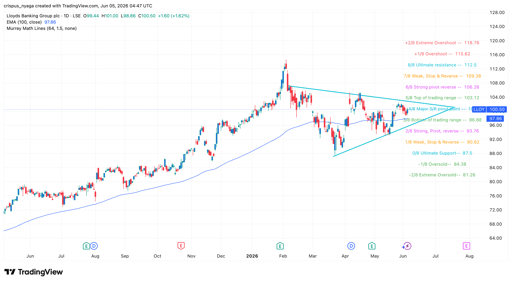
LLOY stock chart | Source: TradingView
The daily chart shows that the LLOY stock price has remained inside a narrow range in the past few months. It has formed a symmetrical triangle pattern whose two lines are nearing their confluence level, where most rebounds or crashes happen.
The stock is supported by the 100-day Exponential Moving Average (EMA) and is stuck at the Major S/R Pivot Point of the Murrey Math Lines. Therefore, these technicals suggest that the stock will rebound in the near term, potentially moving the strong pivot reverse level of 106.26p.
READ MORE: UK house purchase approvals rise above expectations in April

Nvidia, AMD, Intel stocks slide premarket: why investors are suddenly taking profits

Micron stock has surged 220%: here’s the risk bulls may be underestimating

Nikkei 225 catches Nvidia’s tailwind, but KOSPI finds a reason to sell instead

Samsung stock retreat again: why a massive payout isn’t enough for investors

Why Marvell stock is slipping despite a classic ‘beat and raise’
No results found
Loading articles...
Failed to load articles. Please try again.