
US overtakes Saudi Arabia and Russia as world’s top oil exporter
AI Sentiment: 78/100 Bullish
This score is generated through AI-driven analysis of the article's content.

powered by

Buy WTI crude exposure (e.g., USO ETF or WTI futures). The US is now the top exporter and the “swing” supplier, so any supply disruption (Iran, Russia, attacks) is more likely to tighten global balances and keep WTI supported. US shale also responds quickly to price signals, reducing the chance of a sudden supply collapse and supporting a higher floor for prices.
Key Risk: A fast, durable deal that sharply reduces Iran/Russia disruptions and lets non-US supply flood back, crushing the tightness premium.
Sell OPEC+ pricing-power proxies by going long US energy and short more cartel-exposed names: buy XLE (broad US energy) and sell XOP (more E&P/US beta) only if you want pure US strength; otherwise, short Saudi/Russia-linked exposure via energy majors with heavy Middle East/Russia sensitivity (e.g., Shell/TotalEnergies) and/or sell OPEC-linked ETFs if available. The news implies weaker OPEC+ control as US exports rise and Europe/Asia rely more on US barrels.
Key Risk: OPEC+ successfully cuts output enough to reassert price control despite higher US exports, restoring margins for global oil producers.
- US oil exports hit 10.5 million bpd in May, top global exporter.
- Shift driven by shale boom and Middle East supply disruptions.
- Gives Washington new geopolitical leverage in energy markets.
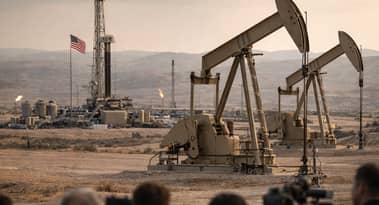
The United States has become the world’s largest oil exporter, surpassing traditional heavyweights Saudi Arabia and Russia, a dramatic shift accelerated by the ongoing US-Iran war and years of shale-driven production growth.
This milestone marks a profound reversal for a country that once suffered greatly from the 1973 Arab oil embargo, imposed in retaliation for US support of Israel.
Back then, long gas lines and economic pain defined America’s energy vulnerability. Today, it wields significant influence as the top global supplier.
Exports hit record levels
US exports of crude and refined fuels reached approximately 10.5 million barrels per day in May, according to ship-tracking data from Vortexa.
This marked the third consecutive month the US held the top exporter position. In comparison, Russian exports stood at around 7 million bpd, while Saudi Arabia’s were at 5.9 million bpd.
Just a year earlier, Saudi Arabia exported about 8.1 million bpd, while the US shipped 6.6 million bpd.
The rapid change reflects disruptions to Saudi and Russian supplies due to the Iran conflict, Ukrainian attacks, and sanctions.
Shale revolution transforms US energy role
America’s rise began after 2010 when shale oil and gas production soared. The country first became the world’s top gas producer, then the top oil producer.
The lifting of a 40-year export ban in 2015, a legacy of the 1973 embargo, opened the floodgates for US crude to reach global markets.
Unlike OPEC nations, where governments control output, the US boom is driven by private companies responding to market signals and profit opportunities.
Kenneth Medlock III, a fellow in Energy and Resource Economics at the Baker Institute for Public Policy, explained in the Reuters report:
In many ways, it’s kind of a similar role to what OPEC and Saudi Arabia have been doing with spare production capacity, but it’s more of a market mechanism than a strategic device.
Geopolitical leverage grows
The new dominance gives Washington powerful leverage in international relations.
“Washington has a new tool they didn’t realize they had before the Iran war — energy exports,” Michelle Brouhard, head of policy at ship tracking firm Kpler was quoted in the report.
Europe now takes about 47% of US oil exports this year, up from 37% in 2021. Asia’s share has also grown significantly.
However, some EU officials have begun warning about over-reliance on American energy supplies, especially amid trade tensions.
Market implications
US dominance could weaken OPEC+ pricing power. President Donald Trump has long criticised the group for market manipulation.
The cartel faced another setback in May when the United Arab Emirates exited after nearly 60 years of membership.
The US energy sector’s flexibility, increasing output when prices rise and cutting back when they fall, provides a natural stabilising effect on global markets, contrasting with state-controlled production in other major producers.
Long-term significance
US crude and liquids output has nearly tripled since 2000 to around 22 million bpd, while Saudi and Russian production have been far less dynamic.
Global oil demand grew from 87 million bpd in 2010 to 104 million bpd last year, with the US meeting much of that increase.
This energy independence and export strength enhance US national security and economic influence.
It also reshapes global alliances, as countries increasingly look to American supplies amid Middle East instability.
The transformation from embargo victim in 1973 to dominant exporter in 2026 represents one of the most significant shifts in global energy history, driven by technology, private enterprise, and timely geopolitical circumstances.
As the Iran conflict continues, the US position as the world’s swing supplier appears firmly entrenched for the foreseeable future.

Trump administration eyeing stake in Venezuelan oil fields? Here's what we know

Gold slips below $4,600: could Warsh turn this pullback into something bigger?

Is Brent setting a trap below $90 as Russia quietly tightens fuel supply?

USDT gold and silver options expand crypto’s push into commodity markets

Brent price forecast: could oil fall below $85 as Hormuz fears ease?
No results found
Loading articles...
Failed to load articles. Please try again.