
HSBC share price forms a doji candle: Is it setting the stage for a rally?

AI Sentiment: 72/100 Bullish
This score is generated through AI-driven analysis of the article's content.

powered by

Buy HSBA.L. The chart shows a dragonfly doji/abandoned baby reversal after a sharp rebound off ~1,267p, plus price holding above the 100-day EMA—classic setup for a near-term squeeze higher. Upside targets: 1,400p first, then 1,500p if it clears the 1,416p YTD high area. Dividend yield (~4.1%) supports the floor while the technicals play out.
Key Risk: A renewed selloff that breaks below the recent low (~1,267p), proving the reversal pattern was just a bounce.
Sell Lloyds (LLOY.L) and/or Barclays (BARC.L) relative to HSBC. The article flags HSBC-specific catalysts (China wealth push, higher dividend, and a technical reversal), while also highlighting credit-loss pressure and uncertainty that can hit the whole sector—so rotate away from banks with weaker near-term technical setups and less clear upside momentum.
Key Risk: Sector-wide bank rally driven by falling rates/credit stress easing that lifts all majors, wiping out the relative-performance edge.
- HSBC share price has jumped in the past few days.
- It formed a doji and an abandoned baby candlestick pattern.
- The company is cutting costs and working to boost its profits.
The HSBC share price has remained inside a narrow range in the past few months as investors assess its performance. It was trading at 1,320p on Thursday, up by 4.2% from its lowest point this week. It may be ripe for more gains in the near term after forming a highly bullish pattern.
HSBC share price forms a bullish reversal candle
The daily chart shows that HSBC's stock price rebounded from a low of 1,267p on Wednesday to a high of 1,320p. A closer look shows that the stock formed a dragonfly doji candlestick pattern. This pattern consists of a long lower shadow and a tiny body, implying that the stock opened and closed at the same price.
The stock also formed what looks like an abandoned baby candlestick pattern. This pattern happens when a small candle opens much lower and is separated from the other candles. It normally happens during a downtrend and often leads to a strong bullish reversal.
The stock also bottomed above the 100-day Exponential Moving Average (EMA), a highly bullish sign in technical analysis. Therefore, there is a likelihood that the stock will continue rising in the near term, potentially to the key resistance level at 1,400p, a few points below the year-to-date high of 1,416p. A move above that level will point to more gains, potentially to 1,500p.
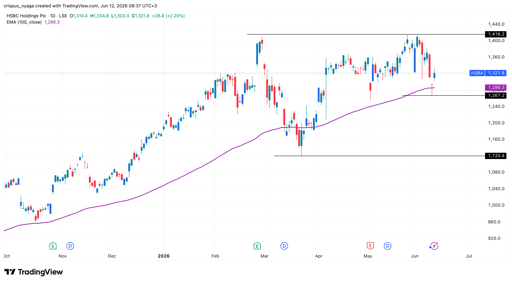
HSBC stock chart | Source: TradingView
HSBC business is sending mixed signals
HSBC, the biggest European bank by assets and market capitalization, is working through a long turnaround strategy under Georges Elhedery. In a recent statement, the company urged its staff not to fight artificial intelligence (AI), saying that the technology would lead to job losses while creating new ones.
He said that as the company started its layoffs, which could cost over 20,000 people their jobs. These jobs would be about 10% of the total workforce, a move intended to save costs and boost its profitability. It also aims to cut costs, including by the privatization of Hang Seng Bank.
In its recent results, the company reported mixed earnings. On the negative side, the company said that its first-quarter pre-tax profit came in at $9.4 billion, missing what analysts were expecting. Its revenue jumped to $18.6 billion, higher than the expected $18.49 billion.
The company’s profits narrowed because of its large credit losses, which jumped to $1.3 billion, higher by $400 million from the same period last year. It noted that the losses were fraud-related because of its exposure to MFS, a UK company that collapsed earlier this year. This exposure has pushed the company to slow down on its private credit strategy, a year after announcing its launch.
At the same time, HSBC pointed to the impact of the ongoing US-Iran war, which led to major disruptions in some of its key assets. It maintained that its return on tangible equity (RoTE) would be 17%, but said this would depend on how the war ends.
For investors, HSBC offers a good risk-reward ratio as it has room to grow its business in China. Its goal is to become a major wealth manager in the country. At the same time, the company offers a 4.13% dividend yield, higher than Lloyd’s 3.62% and Barclay’s 2.45%.

Dow falls 250 pts as oil, Treasury yields rise and Fed rate hike bets grow

Nio stock: Why Tesla rival dropped despite strong revenue growth
Robinhood stock rises as Morgan Stanley upgrades HOOD to overweight

Nvidia stock analysis: top reasons why the shares may go parabolic soon

Broadcom stock falls to a key support: is it about to surge after earnings?
No results found
Loading articles...
Failed to load articles. Please try again.