
Russia secures Indonesia oil pact amid Asia’s supply shock

AI Sentiment: 72/100 Bullish
This score is generated through AI-driven analysis of the article's content.

powered by

Buy Indonesian refiners with high import-to-output leverage—especially PT Pertamina (via listed proxies like PTBA? use refinery exposure through Indonesian energy equities) and regional refiners that can process Russian ESPO/Sakhalin blends. The pact locks cheaper, steadier crude into Indonesia’s structural deficit (gasoline imports up to ~60%), supporting higher utilization and margins as supply risk falls after US waivers.
Key Risk: Russia’s preferential pricing disappears or cargo quality/grade mismatch forces Indonesia back to higher-cost non-Russian barrels.
Sell broad Russian oil producers’ listed exposure that depends on tight sanctions pricing—e.g., Gazprom Neft and Rosneft ADR-style exposure where available—because the market is already repricing “waiver-enabled” demand. The Indonesia deal is real, but it’s likely to be priced as a discount trade with payment friction (USD settlement unlikely), capping upside versus expectations.
Key Risk: A new sanctions tightening or enforcement change blocks the Indonesia route or makes barter/infrastructure payments unworkable.
- Russia offers Indonesia 100M barrels at discounts.
- Jakarta faces crude and gasoline deficits despite refinery capacity.
- Moscow eyes ESPO crude, Tuban refinery revival with Rosneft.
Russia is leveraging Asia’s oil shock to deepen ties with Indonesia, offering a massive supply deal and potential infrastructure investment as Jakarta struggles with crude and gasoline deficits, OilPrice.com reported.
The arrangement could reshape Southeast Asia’s energy map and test the limits of US sanctions policy.
Russia seizes opportunity from Middle East turmoil
According to OilPrice.com, Russia has emerged as one of the clearest commercial beneficiaries of the US–Israel war with Iran.
Before March 2026, buying Russian crude was widely treated as a sanctions risk, with only Chinese and some Indian firms willing to absorb it.
That changed when Washington issued waivers for Russian barrels on March 12, acknowledging that Asia could not balance its oil market without Russian supply.
Successive extensions encouraged regional buyers to view Moscow not only as an emergency supplier but as a long‑term energy security partner.
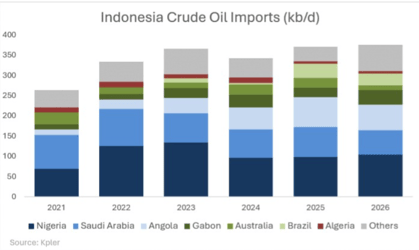
Indonesia, which imports around 370,000 barrels per day of crude and relies on overseas suppliers for about 430,000 barrels per day of gasoline, has become a prime candidate for deeper engagement.
The country’s refining system runs at about 950,000 barrels per day, below its 1.2 million b/d capacity, leaving a structural deficit that forces heavy reliance on imports.
Jakarta’s energy imbalance
Indonesia’s crude output has fallen to 577,000 barrels per day in May 2026, well below the government’s 610,000 bpd target and far from the 1.5 million bpd levels of the 1990s.
Domestic production is insufficient for its refining system, and some local crude is too light for domestic plants.
The imbalance is even sharper in refined products: total petroleum demand is around 1.6 million bpd, forcing Jakarta to import both crude and fuels.
Gasoline demand is about 690,000 bpd, with imports covering as much as 60%.
Diesel imports are smaller thanks to a biodiesel mandate, but Indonesia still buys volumes overseas.
Russia has already supplied sporadic cargoes, including 26,000 bpd in April 2026, and two shipments of Sakhalin Blend crude earlier this year.
The 100‑million‑barrel deal
The turning point came after President Prabowo Subianto’s visit to Moscow in April.
OilPrice.com reported that Russia committed to supplying Indonesia with 100 million barrels of oil at preferential prices, with an option for another 50 million barrels.
Jakarta quickly created a legal route: a regulation in late April authorized public service agencies to import crude and fuels under intergovernmental cooperation.
On June 8, Indonesia’s energy ministry assigned Lemigas, a state agency, responsibility for crude imports, shielding Pertamina from direct ties with sanctioned Russian firms.
Payments remain a challenge, as US dollar settlement is unlikely.
Indonesia’s Energy Minister Bahlil Lahadalia said Russia had expressed willingness to help build infrastructure, potentially including storage terminals or reviving the stalled 300,000 bpd Tuban refinery project with Rosneft.
Such barter‑style arrangements could reduce reliance on conventional monetary settlement.
Strategic implications for Asia
Potential Russian grades for Indonesia include ESPO from Kozmino, Sokol from Sakhalin‑1, and Urals from Primorsk.
ESPO is the most likely option, given its proximity and compatibility with Indonesia’s refining mix.
Longer voyages from Primorsk or Sakhalin could be viable if discounts are deep enough.
The report noted that Indonesia’s case is significant because it is neither a traditional Russian client nor a market able to absorb unlimited sanctions risk.
Yet the shift is clear: Russian oil is increasingly being treated in Southeast Asia not as a prohibited commodity but as an instrument of national energy security.
The Philippines and Vietnam have also begun exploring Russian imports under similar frameworks.
What began as an emergency response to Middle East supply disruptions is evolving into a structural reorientation.
For Russia, the Indonesian opening represents a chance to embed itself in Asia’s energy landscape.
For Jakarta, it offers a way to secure supplies and potentially unlock stalled infrastructure projects.
For Washington, it raises the question of whether sanctions policy can coexist with the energy needs of large importers.

Amos Hochstein dubs oil prices 'wrong and too low': find out more

Gold price forecast: Oil and US bond yields rally ahead of FOMC
Brent nears $108 after Saudi pipeline hit: why $120 oil is back on the table
WTI crude oil price forecast as Middle East risks remain elevated: can it hit $120?
Here’s why Brent crude oil price is falling today and what's next
No results found
Loading articles...
Failed to load articles. Please try again.