
Brent crude oil forecast by Goldman Sachs, Citi, Morgan Stanley, JPMorgan

AI Sentiment: 18/100 Bearish
This score is generated through AI-driven analysis of the article's content.

powered by

Buy UKOIL (Brent crude futures/ETN) on a mean-reversion bounce after the oversold flush. The news is supply-positive (Hormuz reopened, surplus risk flagged by multiple banks) and price is already down hard (near $73, RSI ~28). That combination often creates a short-term snapback even if the medium-term bias stays lower. Target a rebound toward the broken 50-day EMA zone; exit if it fails to reclaim key resistance.
Key Risk: A fast breakdown through $70 that turns the oversold reading into a new downtrend, driven by renewed supply fears or demand collapse.
Sell SLB (Schlumberger) because lower Brent forecasts flow into capex cuts and slower project starts. When banks start talking about surplus and demand destruction, the market reprices the whole oil spending cycle, hitting service names first. Expect multiple compression as investors rotate from “activity” to “survival” in the sector.
Key Risk: Oil prices stabilize quickly (Brent rebounds and stays above $80), forcing investors to re-rate service demand and capex expectations.
- Brent crude oil price continued its strong downward trend.
- Analysts from Goldman Sachs, Morgan Stanley, and Citigroup lowered their estimates.
- Goldman Sachs predicts that there will be a supply glut in the near term.
Brent crude oil remained under pressure this week as traffic through the Strait of Hormuz ramped up and as top Wall Street banks like Goldman Sachs, Citigroup, and Morgan Stanley lowered their expectations. It dropped to $73.25, down by 38.8% from its highest point this year.
Goldman Sachs, Morgan Stanley, and Citigroup lower oil forecasts
Top analysts are slashing their crude oil price targets as they predict robust supplies following the reopening of the Strait of Hormuz.
In a note, Goldman Sachs predicted that Brent crude will average about $80 a barrel in the fourth quarter, down from $90. It expects WTI to average $75, with the bank’s analysts flagging the potential for oil surplus.
Morgan Stanley, on the other hand, predicts that Brent will average $75, while Citigroup slashed its estimate $70. JPMorgan expects it to average $86 in the third quarter and $80 in Q4.
These banks have slashed their outlook because of the recently signed deal between the United States and Iran. This deal has reopened the Strait of Hormuz, with recent data showing that traffic continued to pick up.
There are millions of barrels of oil seeking to pass through the Strait, which will add to the global supply. This is on top of the “extra” oil that emerged during the war, including through Saudi Arabia’s pipeline. The US and Canada also boosted their oil exports as the war ramped up.
Most notably, analysts believe that, despite the threats, Trump is not interested in restarting the war against Iran. Some important midterm elections are coming up and his approval rating has slumped to a record low. Restarting the war will worsen the situation.
Trump also understands that Iran has an upper hand in the escalation ladder. It has so many targets left in its arsenal, including shutting down the Red Sea and energy targets in the Middle East.
The robust oil supplies are coming at a time when demand concerns remain. In a recent report, the International Energy Agency (IEA) warned of the significant demand destruction because of the elevated prices and supply issues.
Brent crude oil price forecast
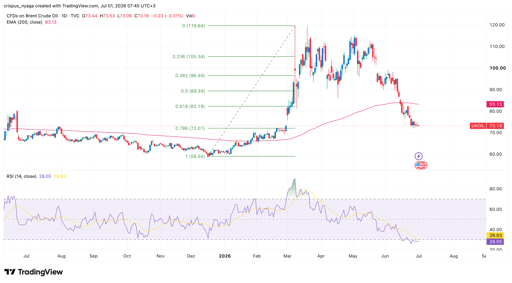
Crude oil price chart | Source: TradingView
The daily chart shows that Brent continues its strong downward trend this week. It moved to a low of $73.2 today, and is hovering at the lowest level since February this year.
Brent has dropped below the 61.8% Fibonacci Retracement level. It is also approaching the 78.2% retracement point. Also, it has slumped below the 50-day and 200-day Exponential Moving Averages (EMA), while the Relative Strength Index (RSI) has dropped to the oversold level of 28.
There are signs that the downward trend is gaining momentum, which may push it lower in the near term. If this happens, there is a risk that it will drop below the crucial support at $70.

Hang Seng Index: Top 3 reasons Hong Kong stocks are falling today

Nikkei 225 Index outlook: top catalysts for Japan stocks this week

Crude oil prices retreat: Brent, WTI slip even as rebound risks persist

Kospi Index at a crossroads as Samsung, SK Hynix leverage bets reverse

Trump administration eyeing stake in Venezuelan oil fields? Here's what we know
No results found
Loading articles...
Failed to load articles. Please try again.