
Silver price crash deepens: Is the critical $57 support about to break?

AI Sentiment: 18/100 Bearish
This score is generated through AI-driven analysis of the article's content.

powered by

Higher oil costs are feeding inflation expectations and rate-hike odds, which typically strengthens the USD versus commodities like silver. If the Fed reprices higher, the dollar bid can persist even while silver weakens. Buy UUP as a cleaner expression of the “higher-for-longer rates” impulse.
Key Risk: Fed signals turn dovish or inflation fears cool, causing the dollar to reverse and commodities to rebound.
Oil-driven inflation fears are pushing yields up and making non-yielding silver less attractive; the article flags $57 as the key line. If $57 breaks, momentum likely accelerates and longs get forced out. Sell SLV (or short silver futures) with a focus on a breakdown below $57 and continued failure to reclaim $58.
Key Risk: Oil shock fades fast and rates expectations drop, letting silver reclaim $58 and buyers defend $57.
- Silver hovered near $57.60 after touching a fresh two-week low in Asia.
- Brent’s sharp rally lifted inflation fears and strengthened rate-hike bets.
- Industrial demand concerns add pressure to silver’s near-term outlook now.
Silver extended its decline for a third session on Tuesday as a renewed surge in oil prices revived inflation concerns and strengthened expectations that the Federal Reserve may raise interest rates again.
Spot silver traded near $57.60 an ounce during Asian hours after touching its lowest level in about two weeks.
The metal has struggled to draw lasting support from worsening US-Iran tensions because the conflict is lifting energy costs, bond yields and interest-rate expectations at the same time.
Oil shock overwhelms haven demand
President Donald Trump said the US would reinstate its blockade of Iranian shipping and seek a 20% reimbursement fee on cargo passing through the Strait of Hormuz.
The announcement intensified concerns about flows through a waterway responsible for roughly a fifth of global oil and gas shipments.
Brent crude climbed as high as $85.64 a barrel on Tuesday, its strongest level since mid-June, after settling almost 10% higher in the previous session.
For silver, the oil rally has proved more damaging than supportive.
Higher fuel costs threaten to feed back into consumer prices, reducing the appeal of non-yielding precious metals when bond returns are rising.
Silver tests a crucial support zone
Silver is hovering near an important technical area after extending its decline for a third consecutive session.
The metal is trading around $57.60, leaving the psychological $57 level as the immediate line of defence for buyers.
A decisive break below $57 could strengthen bearish momentum and expose silver to a deeper pullback as traders reduce long positions.
Repeated failures to hold this area would also suggest that the recent upward trend is losing strength.
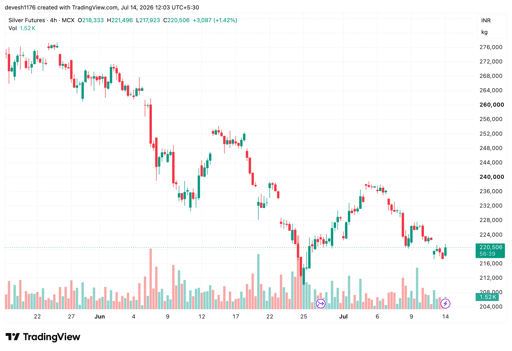
On the upside, silver needs to recover above $58 to ease the immediate selling pressure.
A sustained move beyond that level could encourage fresh buying, while another rejection would keep the short-term bias tilted towards further losses.
Industrial demand adds another layer of uncertainty
Silver’s large industrial role also separates it from gold during periods of tighter financial conditions.
The metal is widely used in electronics, solar panels and other manufacturing applications, leaving it exposed to concerns about slower global growth.
Higher energy costs could squeeze factory margins and weaken demand if companies delay investment or reduce production.
That risk may become more important if the conflict in the Middle East keeps oil elevated for an extended period.
For now, silver is caught between two competing forces.
Geopolitical uncertainty is supporting its haven appeal, while higher borrowing costs and concerns about industrial consumption are limiting the upside. That tension could keep prices volatile around the recent two-week lows.

Gold hits 3-month high as weak dollar and Fed bets put $4,700 in play

Crude price forecast: Oil falls, but Iran tensions keep $100 target alive

Why is gold rallying and could US debt fears send it to $5,000?

Oil climbs near $94: could Hormuz and Red Sea risks send Brent through $100 soon?

Brent nears a four-week high: how high can oil go from here?
No results found
Loading articles...
Failed to load articles. Please try again.