
Micron stock plunges: Has it topped, or is this a rare buying opportunity?

AI Sentiment: 35/100 Bearish
This score is generated through AI-driven analysis of the article's content.

powered by

Buy Micron (MU). The article shows accelerating revenue and gross margin (Q3 revenue $41.5B; guidance to $50B; gross margin to 86%) plus a cheap valuation (forward P/E 13.4; PEG 0.08). The selloff is driven by profit-taking and “2023 inventory hangover” fears, not a collapse in fundamentals. Technicals also suggest a likely bounce zone near the 100-day moving average (~$743) after the head-and-shoulders-like breakdown.
Key Risk: Hyperscalers cut AI/DRAM demand or capex, causing prices and volumes to fall fast enough that guidance misses and margins compress.
Sell the DRAM ETF (DRAM) into strength. The article highlights broad profit-taking across memory (DRAM ETF down 32% from highs) and the market’s reflex to inventory/revenue reversals. Even with MU fundamentals improving, the sector can keep de-rating if investors keep rotating out of memory until inventory clears and pricing stabilizes.
Key Risk: Memory pricing re-accelerates and inventory stays tight, forcing the sector to rebound and leaving the ETF’s downside thesis wrong.
- Micron stock has dropped by about 30% from its highest point this year.
- The company’s fundamentals are still strong, with its revenue growth accelerating.
- Technicals suggest that the stock may retreat further before bouncing back.
Micron stock has plunged since reaching a record high of $1,255 on June 25.
Shares have fallen about 30%, mirroring the sharp declines seen across the memory chip sector, including industry leaders Samsung and SK Hynix.
So, has Micron reached its peak, or is this pullback a golden buying opportunity?
Micron stock is falling despite its robust growth
The ongoing Micron share price plunge is happening despite the fact that the company is firing on all cylinders.
It has become one of the fastest companies in the United States, and analysts predict that the trend will continue.
In its recent numbers, the company said that its revenue growth has accelerated, helped by the increased spending. Its revenue jumped to $41.5 billion in the third quarter, with its gross margin hitting 84.6%. The margin growth was driven by the rising volume and prices.
Micron’s revenue figure is important because it was higher than the $37 billion it made in the last fiscal year.
Also, the company’s guidance showed that the growth is not decelerating, with revenue expected to jump to $50 billion and its gross margin coming in at 86%.
Historically, Micron has always been a highly conservative company, meaning that its real figures will be higher than these.
There are signs that the AI demand is set to accelerate in the coming months, with many companies publishing strong numbers.
ASML published a strong report this week and hinted that it was considering hiking the price of its machines. TSMC also released strong numbers earlier today.
Most importantly, despite its strong growth, Micron is still not a highly overvalued company. Its forward price-to-earnings ratio has slipped to 13.4, which is lower than the technology sector median of 25 and its five-year average of 74.
With growth included in this metric, the company has a forward PEG ratio of just 0.08, smaller than the sector median of 1.37.
Indeed, most analysts tracking the company have a bullish outlook. MarketBeat data shows that 35 of these analysts have a buy rating, with only 3 of them having a hold rating.
KeyCorp’s John Vinh hiked the target from $1,600 to $1,750 on July 14. DA Davidson’s Gil Luria hiked from $1,500 to $2,000.
Profit-taking and lessons from history
The ongoing Micron stock crash is mostly because of a few reasons. First, there are signs that investors are booking profits not only in Micron but also in other memory names. This explains why the DRAM ETF has dropped by over 32% from its highest point this year.
Second, investors are worried that history may repeat itself. This is where memory stocks and revenue growth surges and then drops as inventories start rising. This happened in 2023 when Micron’s revenue dropped to $15 billion from $30 billion.
Third, there are concerns that the room for memory chip price growth is narrowing, a move that may accelerate if top hyperscalers start cutting their capital spending plans.
What next for MU stock?
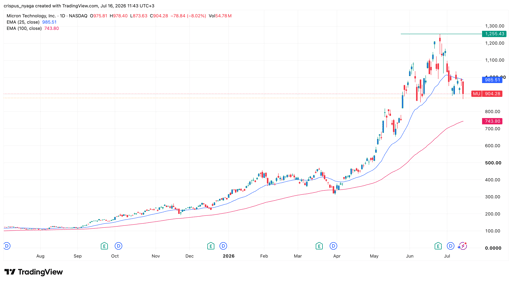
MU stock chart | Source: TradingView
Technical analysis suggests that the Micron share price will likely come under pressure for a while as profit-taking continues. It has formed a head-and-shoulders-like chart pattern and moved below the 25-day moving average.
The most likely scenario is where it continues falling, potentially to the 100-day moving average of $743 and then bounces back. A drop below that level will point to more downside.

HPE stock declines 8% on Monday: here's why

Netflix stock rises as Evercore raises price target to $110

Why Wedbush and BofA issued bullish notes on Roblox stock today

AI panic triggers a rally in CrowdStrike stock

Nvidia stock: Should investors buy the dip amid AI slowdown fears?
No results found
Loading articles...
Failed to load articles. Please try again.