
Uniswap price forecast: Can UNI break $3.58 ahead of crucial governance vote?

AI Sentiment: 68/100 Bullish
This score is generated through AI-driven analysis of the article's content.

powered by

Buy UNI. Catalyst is governance that can link UNI burns to real trading fees across v2/v3 and Uniswap v4, with Robinhood Chain already showing $6B+ Uniswap volume. Setup: UNI is recovering, trading above 20/50/100-day EMAs, and is pressing the $3.58 resistance—expect a breakout if the vote supports fee/burn expansion. Key trigger: daily close above $3.58 to target the next resistance near $3.71.
Key Risk: The governance proposals fail or are watered down, so fee/burn expectations don’t translate into higher actual UNI burns.
Buy a UNI call spread (e.g., buy 1–3 month calls around $3.60 and sell calls around $3.75). This targets the specific event-driven move: a close above $3.58 followed by momentum toward $3.71. It also limits damage if UNI chops around resistance while governance headlines are digested.
Key Risk: UNI rejects $3.58 and falls back below $3.45, killing the breakout narrative and collapsing call premium.
- UNI faces key resistance at $3.58 and support at $3.45.
- Governance vote could expand protocol fee-funded UNI burns.
- Robinhood Chain has surpassed $6 billion in trading volume.
Uniswap's native token, UNI, is approaching a key technical level just as the protocol prepares for a governance vote that could reshape its token economics.
At the same time, governance proposals tied to protocol fees and token burns have added a fresh fundamental catalyst that could keep UNI in focus over the coming days.
UNI was trading at $3.50 at the time of writing, down 0.6% over the past 24 hours after moving between $3.41 and $3.55 during the session.
Despite the slight daily decline, the token has gained 16% over the past 30 days, showing improving momentum after a prolonged period of weakness.
Governance vote puts UNI tokenomics in the spotlight
The upcoming governance vote centers on two proposals that could expand Uniswap's protocol fee system and increase the amount of UNI removed from circulation through token burns.
One proposal seeks to activate protocol fees for Uniswap v4, while another would extend protocol fees to Uniswap v2 and v3 deployments on Robinhood Chain.
We just submitted two Uniswap governance proposals for final onchain vote:
— Hayden Adams 🦄 (@haydenzadams) July 17, 2026
1) v2 + v3 protocol fees on robinhood chain
2) v4 protocol fees on ethereum, base, arbitrum, robinhood, bnb, polygon, optimism
(third proposal with remaining v4 chains coming soon)
Both direct all new… pic.twitter.com/NUCXxegnte
If approved, protocol fees generated through these deployments would be routed through TokenJar contracts before UNI is ultimately transferred to Ethereum and sent to the project's official burn address.
The proposals have attracted attention because they tie UNI's token supply more closely to actual protocol activity.
Rather than relying on speculation alone, the burn rate would increasingly depend on how much trading takes place across supported Uniswap deployments.
The governance vote comes at a time when Robinhood Chain has emerged as one of the ecosystem's fastest-growing networks.
Since launch, the chain has processed more than $6 billion in Uniswap trading volume.
It has also attracted over $70 million in bridged ETH while total value locked has climbed above $100 million, highlighting the pace of adoption during its early weeks.
If the proposals receive enough support from token holders, Robinhood Chain's trading activity would become an additional contributor to UNI burns alongside other protocol fee sources.
UNI price faces important resistance at $3.58
From a technical perspective, UNI is approaching one of its most important short-term resistance levels.
Current market data shows that $3.58 represents the first major resistance. A daily close above that level would strengthen the current recovery and place the next resistance around $3.71.
On the downside, $3.45 has emerged as the key support level. A break below that price would weaken the recent bullish structure and increase the risk of another move lower.
Momentum indicators continue to show signs of improvement without reaching overheated conditions.
The 14-day Relative Strength Index (RSI) stands at 56.56, placing it in neutral territory.
That suggests buyers have gained momentum during the recent recovery, although neither bulls nor bears have established complete control of the market.
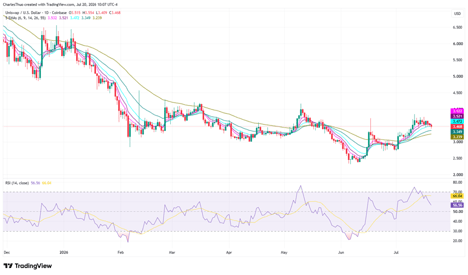
Trend indicators also point to improving price action.
UNI has moved above its 20-day, 50-day and 100-day exponential moving averages, indicating stronger short and medium-term momentum.
However, the token still trades below its 200-day exponential moving average, leaving longer-term resistance intact.
That combination reflects a market where the near-term outlook has strengthened while the broader trend has yet to fully reverse.
Whether the token can extend its recovery may depend on the outcome of the governance vote, which could expand protocol fee collection and increase the amount of UNI permanently removed from circulation through future token burns.

XRP price eyes breakout as traders watch familiar technical pattern

Bybit launches RLUSD Hold & Earn rewards campaign

Are Ethereum bulls preparing a major breakout above the 100-day EMA?

PEPE price coils below its 50-day EMA as breakout pressure intensifies

Why are ADA traders betting against Cardano after a landmark hard fork?
No results found
Loading articles...
Failed to load articles. Please try again.
