
Will AAVE hold above $100 as buyers target resistance at $103?

AI Sentiment: 78/100 Bullish
This score is generated through AI-driven analysis of the article's content.

powered by

Buy AAVE. Catalysts stack: Digital Asset Market Clarity Act push (near-term vote risk premium), “Aave Will Win” revenue-to-buyback demand, V4 cost/capital efficiency, and low dilution (16M capped supply mostly circulating). Technicals confirm: hold above $100 with first support $99.50; need a daily close through $102.80–$103.30 to target ~$106.99.
Key Risk: Congress doesn’t move the bill (or delays it), killing the regulatory catalyst and letting the $99.50 support fail.
Buy AAVE/USDT on a breakout. Enter only after a daily close above $103.30 (Keltner upper band + resistance cluster). This forces the market to reprice the trend continuation toward the next Fibonacci target near $106.99, with upside extension risk toward ~$119 if momentum persists.
Key Risk: Price repeatedly rejects $102.80–$103.30 and closes back below $100, trapping momentum buyers and reversing the breakout.
- AAVE has returned above $100 after rising almost 12% this week.
- The token has benefited from regulatory optimism around CLARITY Act.
- A daily close above the $102.80 to $103.30 range could support more upside.
AAVE has returned above $100 after gaining nearly 12% in the past week, putting the token at a technical crossroads as multiple fundamental catalysts continue to support buying demand.
CoinGecko data showed the decentralised finance token trading near $100.52 at the time of writing, up 8.7% over 24 hours and 11.8% across seven days.
AAVE moved from below $90 earlier in the week, reached almost $102 on July 27 and then settled close to the $100 level.
The advance followed several days of uneven trading between roughly $91 and $98.
After falling toward $91 on July 25 and 26, AAVE recovered sharply, broke through the upper end of that range and moved above $100 as trading activity increased.
Regulatory expectations have been one of the catalysts behind the latest move.
Aave founder Stani Kulechov said the protocol’s team had spent much of the past year, including several recent days, meeting lawmakers in Washington, D.C., over the Digital Asset Market Clarity Act.
Kulechov said Aave was supporting efforts to move the proposed legislation through Congress before lawmakers leave for the late-summer recess.
The Senate’s limited legislative window has added urgency to the discussions.
Kulechov said lawmakers would need to act before the recess, making the bill’s progress a short-term catalyst for AAVE while traders monitor whether a vote takes place.
Protocol economics have also played a role in the token’s recovery.
Through the “Aave Will Win” governance framework, protocol revenue has increasingly been directed toward token buybacks and treasury distributions.
Under the structure approved through Aave governance, part of the revenue generated by lending activity is used to purchase AAVE from the market.
The mechanism has linked token demand more closely with the protocol’s financial performance rather than leaving AAVE solely dependent on its governance function.
Protocol-funded purchases can create a recurring source of demand when lending revenue remains strong.
Aave’s governance framework has therefore given investors a clearer way to measure how platform usage may affect the token’s value, particularly during periods when borrowing and deposit activity rise.
Aave’s latest technology updates have added another source of support. The protocol’s V4 design introduced a modular hub-and-spoke architecture intended to improve capital management across its markets while reducing transaction costs for users.
The structure allows liquidity and risk settings to be managed more efficiently across separate lending markets, according to Aave’s V4 plans.
For institutions and large borrowers, lower operating costs and more flexible market configurations could make the protocol more practical for larger on-chain positions.
Aave Horizon, the protocol’s real-world asset platform, has also expanded its institutional offering by allowing tokenized financial instruments, including products tied to government debt, to be used within lending markets.
Project updates said the initiative had attracted hundreds of millions of dollars in deposits as institutions tested tokenized assets as collateral.
Supply conditions have reduced another source of pressure on AAVE.
Almost all of the token’s capped supply of 16 million units is already circulating, meaning the market faces limited dilution from future emissions or large scheduled unlocks.
Because the remaining supply overhang is small, changes in buying demand can have a more direct effect on the token’s price.
The recent rally has taken place while risk appetite across the crypto market has improved and traders have returned to established DeFi projects with measurable revenue.
Can AAVE hold above $100?
The daily AAVE/USDT chart using VWAP and Fibonacci extensions showed the token trading around $100.51, almost level with the session VWAP at approximately $100.58.
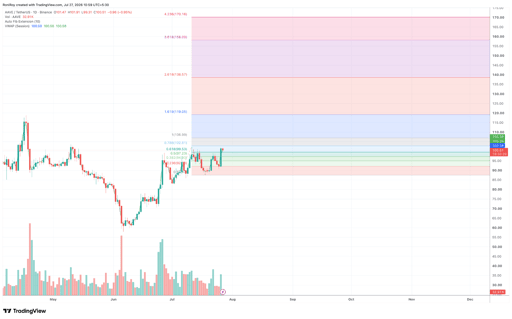
AAVE/USDT 1-day price chart. Source: TradingView.
Holding close to VWAP after the breakout showed that recent buyers had not yet surrendered control of the move.
The same chart placed the 0.618 Fibonacci level near $99.53.
AAVE had reclaimed that area during its latest advance, making the region between $99.50 and $100 the first support zone traders may monitor if the price pulls back.
Above the market, the 0.786 Fibonacci extension stood near $102.81.
This level also aligned closely with the recent intraday high and formed the first technical barrier to a continued rally.
A daily close above $102.81 could open a move toward the 1.0 Fibonacci extension at approximately $106.99, based on the chart.
The next major extension was positioned near $119.05, although reaching that level would first require AAVE to clear the $103 and $107 resistance areas.
On the downside, the Fibonacci chart identified additional support near $97.23, followed by $94.93 and $92.18.
A drop below $99.53 would place the $97 area back in focus, while a break under $94.93 would weaken the structure created during the late-July recovery.
Alongside the Fibonacci setup, the Keltner Channel showed AAVE approaching another resistance area near the upper band at $103.29, almost matching the Fibonacci resistance and the recent swing high.
See below:
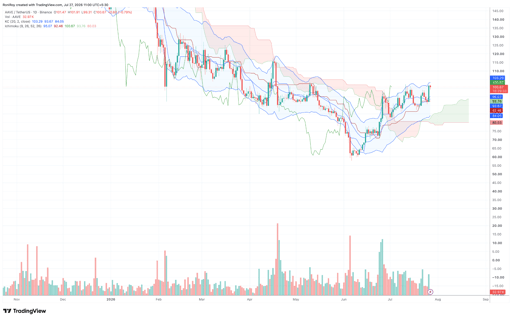
AAVE/USDT 1-day price chart. Source: TradingView.
AAVE was pushing against the upper Keltner band near $103.29, a sign that buying pressure had remained strong since the move above $100.
A daily close above $103.29 could clear the way for a move toward the next Fibonacci target around $106.99, while repeated rejection between $102.80 and $103.30 may keep the token trading sideways in the short term.
The Ichimoku Cloud also continued to favor buyers.
AAVE remained above the cloud, with the Tenkan-sen at $95.07 holding above the Kijun-sen at $92.46, a bullish alignment that suggested the uptrend remained intact after the recovery from June's lows near $60.
Looking ahead, the projected cloud stayed positive, with its upper boundary near $93.76 and the lower edge around $80.03.
This places the primary trend support between $92 and $95, reinforcing the same area identified by the Fibonacci retracement levels as an important support zone if the rally loses momentum.
AAVE’s trading volume has also surged during the rebound from the late-June and July lows, supporting the latest breakout.
For bulls to maintain control, however, AAVE would need to defend the $99.50 support zone and produce a decisive close above the $102.80–$103.30 resistance band before the technical setup favors an advance toward $107.

Pi stabilizes near $0.089 as bulls target a return above $0.10

Bitcoin SV gets rejected at $15.39: was this breakout already a trap?
Dogecoin’s whale buying is rising fast: can DOGE reclaim $0.07 next?

Ethereum whales are buying again, so why can’t ETH break above $2,000?

XRP is testing $1 while whales buy, but the charts still look dangerous
No results found
Loading articles...
Failed to load articles. Please try again.