
Perché le azioni Intel e AMD sono in calo mercoledì?
Sentiment IA: 35/100 Ribassista
Questo punteggio è generato tramite un’analisi basata sull’IA del contenuto dell’articolo.

offerto da

Buy INTC. The selloff is being driven by dilution math (EPS hit) while credit and foundry funding signals are improving (Fitch outlook Stable; equity raise supports foundry buildout). If the market stops treating the offering as a permanent earnings impairment and instead as fuel for customer-backed foundry capacity, the stock can re-rate toward turnaround expectations.
Rischio chiave: Intel non riesce a siglare o a eseguire accordi con clienti foundry di rilievo, trasformando la diluizione in capitale sprecato e ritardando il turnaround.
Sell AMD. Despite the bond raise, the stock is trading like expectations are too high and near-term AI monetization is not keeping pace. The market is selective within semis; if investors rotate away from high-multiple AI winners, AMD’s valuation downside can be sharper than peers.
Rischio chiave: Il ramp-up degli AI accelerator di AMD e la crescita dei ricavi dai data-center deludono, costringendo a ulteriore compressione dei multipli.
- Intel fell as investors continued assessing dilution from its $20 billion offering.
- The Philadelphia Semiconductor Index dropped even as major US indices recovered.
- Broadcom also pulled the semiconductor index lower.
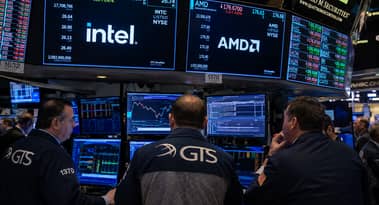
Le azioni Intel e AMD hanno prolungato i cali mercoledì, anche se una più ampia ripresa nei mercati statunitensi ha aiutato i principali indici azionari a recuperare terreno perso nelle sessioni precedenti.
The S&P 500, Dow Jones Industrial Average and Nasdaq Composite all gained between 0.5% and 1% as Treasury yields eased following the US Treasury Department's announcement of an increased buyback operation for longer-term government debt.
Rendimenti obbligazionari più bassi in genere forniscono supporto ai titoli tecnologici migliorando l'attrattiva relativa degli utili futuri.
Tuttavia i titoli dei semiconduttori hanno continuato a sottoperformare.
The Philadelphia Semiconductor Index was down about 2%, with Broadcom also weighing on the group after Marvell Technology announced a custom AI chip agreement with Google.
Broadcom fell about 5%, while both Intel and AMD declined about 4% each.
La debolezza suggerisce che gli investitori restano selettivi nel settore dei chip, con preoccupazioni specifiche per le singole società che si confrontano con i venti favorevoli più ampi derivanti dai rendimenti più bassi e dalla continua spesa per l'AI.
Intel affronta timori di diluizione nonostante l'ottimismo sulla foundry
Il calo di Intel è stato in parte guidato dalle preoccupazioni relative alla diluzione creata dalla sua offerta di azioni ordinarie da $20 billion recentemente completata.
The offering, which closed on August 12 at $95 a share, involved approximately 210.5 million new shares and substantially increased the company's share count.
Bank of America stima che le azioni aggiuntive potrebbero ridurre l'utile per azione di Intel di circa il 4% to 5% una volta che la diluizione sarà incorporata nelle stime prospettiche.
The bank recently reduced its price target for Intel to $145 from $160 while maintaining a Buy rating.
Allo stesso tempo, BofA ha sostenuto che la raccolta di capitale potrebbe rafforzare la capacità di Intel di espandere le sue attività di foundry.
La dimensione del finanziamento, secondo la banca, dimostra la fiducia del management nella capacità di assicurarsi grandi clienti per il business manifatturiero.
UBS has also lowered its Intel price target, cutting it to $112 from $121 while retaining a Neutral rating.
La banca d'investimento ha tuttavia affermato che la raccolta di capitale potrebbe rimuovere un'importante zavorra per il titolo fornendo a Intel le risorse necessarie a finanziare le sue ambizioni nella foundry.
“When combined with pre-payments and financial commitments that we expect to accompany several forthcoming foundry deals (Google for EMIB-T, AAPL for M-Series, AMD, SPCX, and potentially a few more), we believe the raise will allow INTC to fund its foundry buildout,” UBS analyst Timothy Arcuri wrote in a note to clients.
“Overall we view the raise as a strong endorsement of INTC's confidence in its foundry roadmap.”
Intel riceve supporto da Fitch
Intel ha inoltre ricevuto alcuni segnali positivi dai mercati del credito.
Fitch Ratings lunedì ha confermato il Long-Term Issuer Default Rating e i rating senior unsecured di Intel a BBB, mantenendo allo stesso tempo il suo Short-Term IDR e i rating commercial paper a F2.
L'agenzia di rating ha anche rivisto le prospettive portandole da Negative a Stable.
Fitch ha detto che la decisione riflette i progressi di Intel sulla sua roadmap tecnologica e performance operative migliori delle aspettative.
L'agenzia ha inoltre valutato che la recente raccolta di capitale di Intel, mirata a sostenere maggiori spese in conto capitale, rafforza la capacità della società di soddisfare la domanda e ridurre il debito netto.
Fitch expects Intel could begin reducing net debt in 2027 and bring EBITDA leverage below its 2.5 times negative rating sensitivity in the near term.
Questo fornisce un certo supporto alla storia di turnaround a più lungo termine di Intel, anche mentre gli azionisti assorbono l'effetto immediato della diluizione.
L'opportunità AI di AMD si confronta con aspettative elevate
Il calo di AMD è avvenuto anche nonostante il perdurante ottimismo sulla sua posizione nell'infrastruttura AI.
The chipmaker recently priced a $4.75 billion bond offering to support its expansion into artificial intelligence and data centers.
According to NAI 500, it was AMD's largest-ever US dollar bond financing.
The transaction gives AMD additional financial flexibility, including ahead of $875 million of debt scheduled to mature next month.
The financing comes as AMD attempts to capture a larger share of the AI accelerator market and strengthen its position as an alternative to Nvidia.
Wall Street remains broadly optimistic about the company's long-term opportunity.
Baird, UBS, Goldman Sachs, Cantor Fitzgerald and Barclays have raised their price targets in recent months, with targets ranging from about $600 to $1,250.
Gli analisti hanno indicato le CPU e le GPU di AMD, i suoi processori server EPYC e il suo potenziale ruolo nei data center AI e nei sistemi rack-scale come fattori chiave della crescita futura.

Dow perde 600 punti mentre il petrolio sale e crescono le scommesse su rialzi Fed

Riepilogo serale: AMD in rally, oro in calo per scommesse su rialzi Fed
Le azioni AMD salgono del 6% mentre l'opportunità di mercato AI raggiunge $3T

Perché le azioni Nebius volano oggi e cosa aspettarsi

Perché le azioni CoreWeave salgono del 16% oggi
Nessun risultato trovato
Caricamento articoli...
Failed to load articles. Please try again.