
Delhi's Sarojini Nagar: chaos, commerce, and a city’s tug-of-war
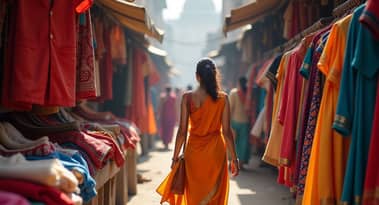

- Sarojini Nagar faces redevelopment, vendors resist, uncertainty grips Delhi market.
- Iconic Delhi market caught between street trade and modern plans.
- Informal sellers fight eviction as Sarojini transforms under redevelopment push.
By Dheeya Singh
Located in South Delhi, Sarojini Nagar Market is a vibrant, chaotic shopping destination that sees over 50,000 visitors on weekdays — and more than 1 lakh on weekends.
Sarojini Nagar Market, famous for selling export surplus at throwaway prices, typically 60-70% less than original prices, attracts college students, budget-conscious families, and fashion hunters from across the city and beyond.
From branded clothing dropped by Western retailers to knock-off accessories, shoes, and even home decor, Sarojini Nagar Market offers it all — often laid out on blue tarpaulins, in makeshift stalls, or crammed into tiny shops.
Altogether, the market hosts around 3,000 retail units (both authorised and unauthorised) across roughly 0.5 to 0.6 square kilometres.
But it’s not just affordability that defines the market — Sarojini Nagar is a culture in itself.
The market is loud, messy, crowded and deeply loved.
In a city that is rapidly moving towards malls and high-rise glass towers, Sarojini remains a stubborn reminder of what public markets once were: accessible, unpredictable and full of life.
From housing colony to fast-fashion hub
But this public market wasn’t always a public market.
In the 1950s, surrounded by Netaji Nagar, Naroji Nagar and Lakshmi Nagar, Sarojini Nagar served as the General Pool Residential Accommodation colonies (GPRA) developed by the Delhi government to provide low-rise housing for government employees.
The area was named after Sarojini Naidu, the freedom fighter, poet, and the first woman governor of an Indian State.
“The Demography has changed," says Prof Prabhas Pandey, a former resident of Sarojini Nagar and a DU professor.
He insists that there has been overcrowding in recent years due to an increase in unauthorised shops.
Sarojini Nagar began with no more than 100 authorised shops, which gradually expanded into the back lanes as the market gained popularity.
Over time, the area became crowded with unauthorised vendors and shops, dramatically altering the market’s atmosphere.
"A dragon had its eye on Sarojini Nagar — and it ate the market up," says Prof Pandey.
The market has evolved into something it was never meant to be — a commercial hub and fast-fashion hotspot.
The economy behind the blue tarpaulins
Aisha, a regular shopper at Sarojini, explains with excitement how the market, because of its affordability, is one of her favourite places to shop.
Apart from being a popular shopping hub, Sarojini is also a massive employer.
Its informal structure means low entry barriers for workers who might otherwise be excluded from formal retail jobs.
Around 80% of Sarojini’s workforce belongs to Delhi’s 4.9 million informal workers, who Delhi hosts, and 9000-15000 livelihoods depend on it.
In economic terms, it is a textbook example of a self-sustaining Urban microeconomy.
But the market is also chaotic — with congested lanes, tangled power lines, undefined shop boundaries, and no clear system of accountability.
Redevelopment vs reality
This is where Redevelopment comes in.
The NDMC Sarojini Nagar Redevelopment Plan(Delhi Master Plan 2021) aims to modernise and enhance the market’s infrastructure.
The plan involves converting the mixed-use buildings into commercial hubs and dealing with the unauthorised encroachments by removing them.
It aims to create an overall better experience for the customers and the vendors while preserving the unique character of the market.
The budget for the same is ₹4,911 crore.
The market, although it seems to be divided on this plan, makes us aware of a massive gap present in the retail unit owners themselves.
The conflict
The newer traders in the market express their discontent over the redevelopment and the removal of “encroachers” who illegally expanded their shops and formed superstructures throughout the market.
The Street Vendor’s Livelihood Act gives these vendors permission to sell in public markets, but not to construct any permanent structures, according to the Supreme Court.
However, the relatively newer vendors over the years have established a permanent structure.
This redevelopment plan would mean the demolition of all these structures that have been unlawfully constructed.
Most of the market's livelihood is generated because of these Shops.
The market’s economic model is based on volume and speed, hundreds of vendors, tiny margins and fast turnovers.
It is not uncommon for a shop to sell hundreds of pieces a day.
The flow is constant, but this flow came to an abrupt stop this May; hundreds of shops with unauthorised superstructures were razed and bulldozed overnight.
Vijay Kumar, a shopkeeper selling bags in one of his five shops for 10 years, remembers being harassed as the superstructure in his shop was broken overnight without notice.
“We have done nothing wrong. This is our livelihood, we have been selling in Sarojini for years, and we will keep selling here."
Vijay’s shop, because of the “Anti Encroachment Drive” on the 17th of May, was shut down for a whole week, making him incur losses; however, after that one week and allegedly some bribes, the NDMC and the police allowed him to resume sales.
Similarly, the market was back on its feet within a few days, although the footfall now was far less; there was a 50% cut in the footfall because of the inaccurate media representations that basically insinuated that the whole market was now shut and in shambles.
Tanmeet ji, the son of the vice president of the Sarojini shopkeepers' association (owner of Amar Jyoti Restaurant), expresses the need for redevelopment in the market “The streets are congested, there is no space to walk, and these people keep constructing these illegal structures. God forbid something happens, there is no space for a fire truck to get in."
He also emphasised that the NDMC and the Police are the ones letting the superstructures be reconstructed time and again, not paying attention to the safety hazards it causes,” It is all for this illicit money that they get out of this”.
He also laid emphasis on the fact that they were not against retail happening but rather the structures being created that hinder the movement in the market and raise safety concerns.
The shoppers agree, Shivam and his group of friends have decided never to visit Sarojini Nagar Market again, “It’s so crowded you can’t breathe. If redevelopment brings a better, more organised experience, then why not?"
The others worry the market will lose its soul. The General Secretary of the shopkeepers’ association, Nitin Bhatia, voices his concern,
“The standardised plans for the redevelopment of our building should have been given to us in 2014 itself, but the construction of the malls all around and the high-rise buildings have already been completed, and we still don’t have a plan. These buildings are old. You have constructed these modern commercial hubs all around us- where will we go? The main market isn’t even visible now. The illegal constructions continue in the market, and the police are doing nothing- where are those redevelopment plans now?"
Between livelihood and legality
The opinions on the redevelopment are vast and divided, while some worry about their financial stability and lost livelihoods, others worry about the safety hazards that the superstructures and crowd pose to the market.
The redevelopment of markets usually takes into account square feet added, trees replanted, and towers built, but Sarojini’s value lies in something that cannot be so easily quantified, its accessibility, feasibility and spontaneity.
The informal economy here is not visible in GDP figures, but it is deeply embedded in Delhi’s social and financial life. It provides employment to thousands.
NBCC says it will preserve the "commercial character and culture” of the market, but what that means in practice is still unclear.
Urban planner Nishita Banerjee explains that spaces like Sarojini Nagar Market are uniquely difficult to plan because they mean different things to different people. For long-time residents, the market is seen as “sacrosanct” — a space that must not be encroached upon.
For others, it represents a place of refuge, a source of sustenance that has accepted and accommodated them over the years.
Also, the safety concern is ever-present in these spaces.
Therefore,
What creates the “culture” of the market is still unclear - is it the shopkeepers who had settled here in the beginning, or is it everything and everyone the market has accommodated and made space for over the years?
What happens next may not be in the hands of the vendors or the authorities alone.
But for now, the market continues—selling, shifting, and standing its ground.
(Dheeya Singh is an intern at Invezz, based in New Delhi and currently pursuing a B.A. (Hons.) in Political Science from Kirorimal College, University of Delhi. She specialises in politics and international relations.)
Dubai strikes back: premium real estate is already rebounding, Ali Sajwani reveals

Is China's economic resilience masking a real estate collapse?

Persimmon share price at risk as key challenges converge

US home loan demand rises 1.8% as mortgage rates ease

Interview: Dubai realty set for 30% dip if war escalates, says ANAROCK's Thakur
No results found
Loading articles...
Failed to load articles. Please try again.