
A breakdown of Sri Lanka’s interim budget amid an economic meltdown
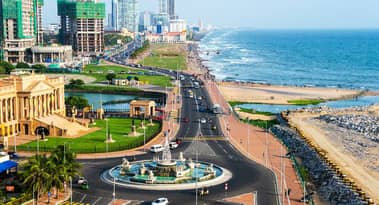

- After coming to power in Sri Lanka, recently appointed FM Wickremesinghe presented the interim budget.
- Government revenues are projected to fall while expenditures as part of the government's new relief measures.
- An ambitious medium term target of 5% growth, single digit inflation and 2% primary surplus has been adopted.
Sri Lanka is in a period of great flux. The breathtaking beauty of the island nation has, unfortunately, often been overshadowed by political instability, ethnic conflict and civil unrest.
With the end of the civil war in 2009, there was widespread optimism in the international community that Sri Lanka may take steps towards greater economic prosperity.
However, a decade later, the country found itself face-to-face with an economic crisis once more. These rumblings worsened exponentially due to the implementation of misguided agricultural and taxation policies, racking up of external debt, a plummeting rupee and of course, the onset of the pandemic which wreaked havoc across sectors.
Although the economic crisis is usually considered to have begun in 2019, W.A.Wijewardena, a former Deputy Governor of the Central Bank of Sri Lanka notes that” in 2015, Sri Lanka was in a deep economic crisis.”
Exports had already begun to stagnate while Sri Lanka, being an island, saw its import costs rise. The deteriorating trade deficit (exports minus imports) is shown in the graph below. Many of these imports comprised the most essential items including food grains, medicines and fuel. This began to pinch the common householder as the business environment grew darker.
When the pandemic was first declared in 2020, Sri Lanka’s tourism sector, the country's third largest foreign exchange earner, was particularly badly hit, with international travel coming to a complete standstill by April. Moreover, the stress on local transport and logistical resources meant that supply chains were heavily compromised.
With the surge in inflation and global market uncertainty, capital outflows were thick and fast, considerably weakening the LKR against the USD.
With severe weakness in the domestic currency and waning foreign exchange reserves, the government was forced to borrow from the international markets, adding to its already sizeable interest payments.
With the fall of the Rajapaksha government, newly-appointed FM and six-time PM, Wickremesinghe, must organize the restructuring of the economy and crucially, place the country in a financial position to enable IMF funding.
Budget highlights
The priority for the government is to rein in inflation, which was registered at 60.8% in July 2022, the highest level in Asia, exacerbated by historic levels of money printing, and a surge in capital outflows.
Although expectations were of a sizeable cut of a “few hundred billion” in expenditure, net expenditure has increased sharply, amid fresh relief measures and additional outlay by the government.
Total expenditure (which comprises both revenue expenditure for administrative purposes such as government salaries and funds allotted for public services such as administration, defence and health; and capital expenditure which creates new assets such as ports, highways and bridges) is projected to rise to LKR 4.4 trillion compared to the earlier estimate of LKR 3.9 trillion.
At the same time, revenues are projected to fall to LKR 2 trillion against the last budget’s estimate of LKR 2.23 trillion.
Given the widening budgetary deficit (revenues down, while expenditures rise), the budgetary deficit was earlier projected at 8.8% of GDP but has been revised upwards to 9.8%.
Much like the budgetary deficit, the primary deficit is another measure which is frequently used to assess the health of an economy. The primary deficit measures expenditure minus revenues but excludes interest payments. This highlights the flow of funds that the government receives versus how much it spends on core aspects of the economy, especially on goods and services.
This deficit is projected to fall to 4% of GDP compared to 5.7% in 2021, which will be a challenging task as growth is expected to contract sharply this year, by an estimated 8%. This implies that taxes (the primary avenue for the government’s revenue collection) will likely not be sufficient due to lower economic activity.
In the medium term, Wickremesinghe has pledged to reach a 2% primary surplus by 2025, a tall ask as the economy is yet to show any positive signs of recovery and a dearth of investable opportunities.
Key points
The reality is that given the financial predicament faced by the government, authorities will have few options but to rely on international funds in the near to medium term.
One of the central aims of the budget is to move the economy towards a point where budgetary ratios are in line with global expectations while authorities attempt to negotiate an emergency loan of around $3 billion with the IMF.
Fiscal Reforms:
Agriculture and animal husbandry:
Tourism and skill development:
Welfare and monetary measures:
With the opening up of global tourism and Sri Lanka's relatively inexpensive labour, the government must leverage these strengths to begin rebuilding the economy.
Although Wickremesinghe has come to power, many commentators believe that given that Rajapaksha's party still controls the majority in parliament, the new government may have a challenging time finding support for its new economic vision.
In a positive development, there is an expectation that the IMF and government of Sri Lanka's talks are reaching a "successful-level."
In November later this year, the government is expected to present a full-year budget that will hopefully shed more light on the country’s future economic roadmap.
Trump is matching up to $1,000 for retirement: do you qualify?

T. Rowe shares rally 7% on $1B Goldman Sachs deal

Interview: Crypto now a 'strategic asset,' not a 'speculative play,' says BlockTrust IRA CEO Jonathan Rose amidst IRA surge

UK Budget 2024: from capital gains tax hike to inheritance tax overhaul—key takeaways
When will the UK budget be announced and what could it include?
No results found
Loading articles...
Failed to load articles. Please try again.