
Bitget Stocks 2.0 review: can a crypto exchange become your stock broker?


- Bitget Stocks 2.0 combines tokenized equities and real US stock trading.
- Stock+ and rTokens offer two distinct paths to US equity exposure.
- Stocks 2.0 advances Bitget's vision of a unified crypto and equity platform.
For years, crypto platforms and traditional brokerages have existed in parallel worlds.
Investors who wanted exposure to both digital assets and US equities typically needed separate accounts, separate funding rails, and separate portfolio management tools.
Bitget's Stocks 2.0 initiative is an attempt to close that gap.
Launched in June 2026, Stocks 2.0 expands Bitget's equity offering beyond tokenised stocks and introduces a dual-track system: tokenised stock exposure through Reality-issued rTokens and direct US stock ownership through Stock+, a brokerage-style product that allows eligible users to purchase real US shares using digital assets such as USDC.
The result is a platform that aims to bring stocks and crypto into a single account environment rather than treating them as separate asset classes.
The question is whether Stocks 2.0 meaningfully improves access to equities for crypto-native investors—or simply adds another layer of complexity to an already crowded market.
Two ways to access stocks
The most distinctive aspect of Stocks 2.0 is that it offers two different paths to US equity exposure.
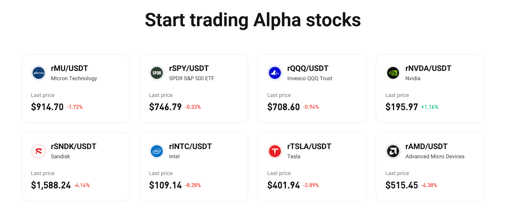
The first is through rTokens, tokenised stock products issued through Reality, a regulated real-world asset issuance platform.
These assets provide economic exposure to underlying US stocks and ETFs while remaining integrated within Bitget's crypto ecosystem.
Examples include rAAPL, rNVDA, rTSLA, and rQQQ.
According to Bitget, the platform now supports more than 500 stock and ETF-linked assets through the rToken framework.
The second is Stock+, which takes a more traditional approach.
Rather than offering tokenised exposure, Stock+ enables eligible users to purchase actual US shares via licensed brokerage infrastructure, funding transactions with digital assets.
The product supports more than 10,000 US-listed stocks and ETFs and includes familiar brokerage features such as market data, portfolio tracking, fractional investing, and corporate-action support.
This distinction matters because tokenized stocks and real shares are often grouped together despite serving different purposes.
Stocks 2.0 acknowledges that some users want direct ownership while others prioritize the flexibility and composability of tokenized assets.
Here is a comprehensive comparison of the two products:
| Product Name | rTokens | Stock+ |
|---|---|---|
| Product Type | Stock tokens | Traditional stocks |
| Issuer | Reality | Companies listed on Nasdaq / NYSE |
| Asset Name | Add “r” before the stock ticker, e.g., rSPCX | Same as the stock ticker, e.g., SPCX |
| Asset Coverage | 500+ major U.S. stocks | Initially covers 10,000+ U.S. stocks & ETFs, with gradual expansion to follow |
| Liquidity | Direct access to markets such as Nasdaq, consistent with traditional brokers | Direct access to markets such as Nasdaq, consistent with traditional brokers |
| Custody & Clearing Institutions | Alpaca Securities | RQD Clearing, Atomic Vaults Securities |
| Trading Experience | Similar to crypto spot trading | Similar to traditional brokerages in Asia |
| Trading Fees | From 0.1%, with a limited-time 50% discount before August 31 | From 0.1%, with a limited-time 50% discount before August 31 |
| CRS Tax Reporting | Not subject to CRS | Subject to CRS, in compliance with international tax regulations |
| Trading Hours | 24/7 for selected major assets | 24/5, covering standard U.S. stock trading hours: pre-market, regular trading, and after-hours |
| Use Cases | Can be used as futures margin, for strategy trading, etc. | Not available for now |
| Shareholder Rights | Cash dividends and stock splits are mapped 1:1 to traditional U.S. stocks; voting rights are not currently available | Full shareholder rights: cash dividends, stock splits, and voting rights, subject to the custody agreement |
| Target Users | Crypto investors with a long-term bullish view on stock fundamentals | Traditional brokerage users and investors seeking real stock ownership |
The crypto-to-stocks pipeline
Perhaps the strongest argument for Stocks 2.0 is convenience.
Traditionally, a crypto investor seeking exposure to companies such as Apple, NVIDIA, or Tesla would need to sell digital assets, transfer funds to a bank account, move capital to a brokerage, and then execute a stock purchase.
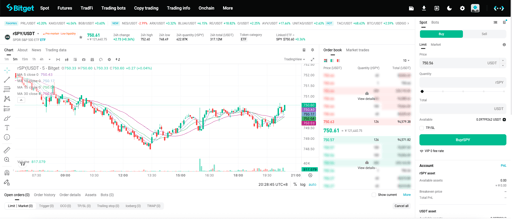
Stocks 2.0 attempts to streamline that process by allowing users to access equity markets from within the same environment where they already hold crypto assets.
Instead of treating stocks as a separate destination, Bitget positions them as another asset class inside a broader portfolio.
For crypto-native users, this may be the product's biggest appeal.
The ability to move between cryptocurrencies, tokenised assets, and equities without leaving the platform reflects the broader industry push toward unified financial infrastructure.
It also aligns closely with Bitget's Universal Exchange, or UEX, strategy, which aims to combine multiple asset classes within a single account experience.
Fractional investing lowers the barrier
Another notable feature is fractional ownership.
Stocks 2.0 allows users to buy fractions of shares rather than requiring full-share purchases.
Bitget says investments can start from as little as 0.0001 shares, making high-priced stocks more accessible to smaller investors.
This functionality is hardly unique in today's brokerage landscape. Platforms such as Robinhood and other digital brokers have popularized fractional investing over the past decade.
However, fractional investing remains particularly relevant within crypto markets, where investors are already accustomed to dividing assets into extremely small units.
The transition from purchasing fractions of Bitcoin to fractions of a US stock feels relatively natural.
Combined with stablecoin-based funding, fractional investing lowers the capital threshold for users who may be exploring equity markets for the first time.
Understanding rTokens
Tokenised stocks remain one of the more misunderstood segments of the digital-asset industry, and Bitget's implementation is no exception.
Reality-powered rTokens are designed to provide 1:1 asset-backed economic exposure to underlying stocks and ETFs while integrating those assets into Bitget's trading ecosystem.
Eligible users may receive dividend distributions and benefit from supported corporate actions such as stock splits.
At the same time, rTokens should not be confused with direct share ownership.
Bitget's own documentation notes that rTokens generally provide economic exposure rather than registered shareholder ownership.
That distinction affects rights such as proxy voting and shareholder participation.
For many traders, that distinction may be less important than liquidity, accessibility, and integration.
But users evaluating tokenised stocks should understand the difference between economic exposure and traditional equity ownership.
The presence of both rTokens and Stock+ within the same ecosystem is therefore one of Stocks 2.0's more practical design choices.
Users are not forced into a single model of equity access.
How rTokens compare with other tokenized stock offerings
Bitget isn't entering an empty market. Platforms such as Ondo and Binance have already introduced their own approaches to tokenized equities.
According to Bitget, its rToken ecosystem differentiates itself through deeper integration with its trading platform, broader functionality, and an emphasis on regulated market access.
Here's how the offerings compare:
| Comparison Criteria | Bitget rToken | Ondo Stock | Binance bStock |
|---|---|---|---|
| Liquidity | High: Direct access to Nasdaq and NYSE, in line with traditional brokerages | Moderate: Primarily supported by market makers | Moderate: Primarily supported by market makers |
| Compliance | Dual regulatory coverage in South Africa and El Salvador. Daily PoR updates provided by an independent third-party auditor | US regulatory license. Only internal asset audit reports are provided | UAE regulatory license. Only internal asset audit reports are provided |
| Financial efficiency | Supports a wide range of advanced features, including use as margin collateral, Level 2 market data, unified accounts, API trading, weekend trading, and strategy trading | Not currently available | Supports limited features, such as use as margin collateral and weekend trading |
Beyond trading
Stocks 2.0 is also notable for how Bitget is positioning stocks within its broader ecosystem.
Rather than functioning solely as standalone investment products, certain tokenised stock assets can be integrated into other platform features, including unified trading accounts, multi-asset margin systems, trading strategies, copy trading tools, and selected yield products where supported.
This reflects a broader shift occurring across digital-asset markets.
Tokenisation is increasingly being viewed not simply as a method of representing traditional assets on blockchain rails, but as a way of making those assets interoperable within digital financial systems.
Whether that vision ultimately gains mainstream adoption remains to be seen.
However, Stocks 2.0 demonstrates how exchanges are beginning to treat stocks as programmable financial assets rather than isolated holdings.
How it compares to traditional brokerages
Comparing Stocks 2.0 directly with established brokerages is not entirely straightforward because the target audience differs.
Traditional brokerages are built primarily for stock investors.
Bitget, by contrast, is attempting to serve users who already operate within crypto markets and want easier access to equities.
Viewed through that lens, Stocks 2.0 is less about replacing a brokerage and more about reducing friction between asset classes.
Investors deeply embedded in traditional finance may still prefer specialised brokerage platforms and long-established workflows.
Meanwhile, crypto-native users may appreciate the ability to manage digital assets and stock exposure from a single interface.
The appeal of Stocks 2.0, therefore, depends largely on user priorities.
Investors seeking a pure brokerage experience may focus on Stock+, while those interested in crypto-integrated equity exposure may find greater value in rTokens.
Verdict
Bitget Stocks 2.0 is less a standalone product than an attempt to unify two investment worlds that have traditionally operated separately.
Its biggest strength is flexibility. Users can choose between tokenised stock exposure through rTokens and direct ownership through Stock+, while funding investments with digital assets and managing them alongside crypto holdings.
The platform will not eliminate the need for traditional brokerages in every situation, nor is it necessarily trying to.
Instead, it offers a different proposition: bringing equities into a crypto-native portfolio environment.
For investors already active in digital assets, that may prove to be the most compelling feature of all.
As exchanges race to expand beyond crypto, Stocks 2.0 offers an early look at what a more integrated investment platform could eventually become.

REAL Finance expands European access as $ASSET goes live on Kraken EU

Can ARB price reach $0.14 after 30% rally powered by Robinhood chain?

BONK jumps 7% as rising futures demand supports a breakout attempt

KuCoin upgrades institutional lending program

Robinhood stock rises as Morgan Stanley upgrades HOOD to overweight
No results found
Loading articles...
Failed to load articles. Please try again.