
Oracle stock is rebounding despite the soaring CDS spread: is it a buy?

AI Sentiment: 42/100 Bearish
This score is generated through AI-driven analysis of the article's content.

powered by

Buy Oracle (ORCL). The stock has reclaimed $134.80 and is rebounding while fundamentals are improving: revenue +20% and cloud +47%, with RPO up $85B to $638B tied to AI customers (OpenAI/xAI/Meta). Valuation is reasonable for the growth (forward P/E ~17). The CDS spike looks like a financing/default fear, but the operating momentum gives you a path to re-rate if credit stress stabilizes.
Key Risk: Oracle’s AI-driven demand slows and RPO growth rolls over, forcing weaker earnings just as refinancing needs rise.
Sell Oracle credit risk via buying protection on Oracle CDS (short CDS exposure / long protection) or avoid Oracle high-yield bonds. The article flags record default risk, junk ratings, and very high bond yields (2046 ~7.5%, 2056 ~7.6%) alongside a plan to raise $40B and net debt up to ~$135B. Even if equity rebounds, credit can stay stressed longer because refinancing and leverage take time to play out.
Key Risk: Oracle’s refinancing goes smoothly (cheaper debt, improved cash flow) and CDS spreads compress fast, making protection expensive.
- Oracle stock has bounced back in the past few days.
- The company’s CDS spread has jumped to a record high as debt concerns remain.
- Oracle’s bond yields have jumped, while its valuation metrics have become attractive.
Oracle stock has rebounded in the past few days as investors have rotated to technology names as the earnings season gains steam. ORCL jumped to $145 on Tuesday, up by 27% from its lowest level this year. So, is the stock a good buy as its CDS spread jumps to a record high?
Oracle’s CDS spread is soaring
Larry Ellison’s Oracle is under pressure. Even with its recent rebound, the stock remains 42% below its highest level this year. Its market capitalization has plunged sharply during this time.
At the same time, investors are concerned about its future as its debt surges. For one, the company’s default risk has jumped to the highest level on record, surpassing where it was during the Global Financial Crisis in 2008.
The default risk is measured using the credit default swap (CDS), a financial instrument that provides protection against the risk of a debt default. A higher CDS spread is usually a sign that investors are demanding a larger premium to insure the debt.
Other measures show that investors are jittery about the company. For example, the company’s bond yields remain at an elevated level. Its 2046 bond yield has jumped to 7.50%, while the 2056 ones have moved to 7.60%. Top credit rating agencies like S&P Global have given it a junk rating.
These metrics come at a time when its debt is soaring. TradingView data shows that its total debt has jumped from $73.6 billion in 2019 to $167 billion today, and the company plans to raise over $40 billion this year. The net debt has jumped from $30.6 billion to $135 billion in the same period.
Oracle is betting the house on AI
Oracle’s total debt has jumped because the company is betting it all on AI. It is a member of the Stargate project that aims to spend over $500 billion in the US.
There are signs that the emphasis on AI is paying off as its remaining performance obligations (RPO) has jumped sharply in the past few months. In the last quarter, its RPO jumped by $85 billion to $638 billion. Most of these deals are with OpenAI, xAI, and Meta Platforms.
While these are all big companies, there are concerns that they will need to slow their AI spending at some points as they focus on their profitability. OpenAI is said to consider delaying its IPO to next year.
If the AI theme works out, then there is a possibility that Oracle will be one of the biggest beneficiaries.
The most recent results showed that Oracle’s business is doing well, with its revenue soaring by 20% to $19.2 billion. Its earnings-per-share also jumped by 21% to a record $1.45.
By segment, Oracle’s cloud segment revenue jumped by 47% to $9.9 billion, with its cloud infrastructure hitting $5.8 billion.
This growth is expected to continue as it fulfils its AI obligations. As a result, analysts expect last quarter’s revenue jumped by 28% to $19.2 billion, while the annual one will soar by 325 to $89 billion.
What next for ORCL stock?
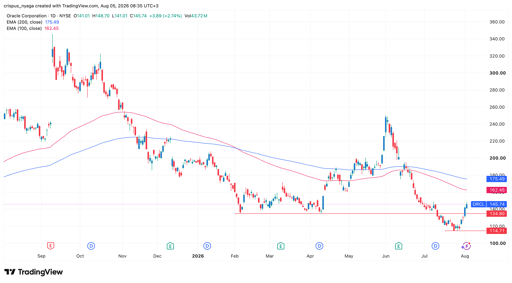
Oracle stock chart | Source: TradingView
Wall Street analysts have a mixed outlook for the Oracle stock price. For example, Guggenheim has a target of $400, while Bernstein and TD Cowen have a target of $325 and $300, respectively. On the other hand, Piper Sandler and JPMorgan are not all that enthusiastic about the company.
The daily chart shows that the ORCL share price has rebounded in the past few days, moving from a low of $114 to the current $145. It has already jumped above the key resistance level of $134.80, its lowest level in February, March, and April this year.
Moving above that level is a sign that bulls are gaining momentum. However, before the stock jumps above the 100-day and 200-day moving averages, there is a risk that this rebound is just a dead-cat bounce.
Fundamentally, however, Oracle’s business is trading at a bargain, with the forward price-to-earnings ratio being 17.

HPE stock declines 8% on Monday: here's why

Netflix stock rises as Evercore raises price target to $110

Why Wedbush and BofA issued bullish notes on Roblox stock today

AI panic triggers a rally in CrowdStrike stock

Nvidia stock: Should investors buy the dip amid AI slowdown fears?
No results found
Loading articles...
Failed to load articles. Please try again.