
Why are Micron, SK Hynix and memory stocks surging today
AI Sentiment: 78/100 Bullish
This score is generated through AI-driven analysis of the article's content.

powered by

Buy MU. AI hardware demand is tightening DRAM supply, and BofA is calling for a structurally stronger earnings phase (FY2030 EPS $200–$250) with a $1,550 target. The China-sourcing pressure adds incremental demand for non-CXMT supply, supporting pricing and utilization.
Key Risk: A sharp memory demand slowdown from AI capex cuts that forces Micron to sell at lower prices again.
Buy SK Hynix. It’s directly leveraged to the same AI-driven DRAM tightness, and it benefits from the US push to discourage Chinese memory sourcing, which can shift share toward Korea-based suppliers. Strong relative momentum (up ~5.6% today) fits a continued supply-constrained tape.
Key Risk: US-China restrictions ease or China supply substitutes quickly, removing the pricing support.
- Memory stocks rise as AI demand and US-China tensions boost sentiment.
- BofA sees Micron FY30 EPS reaching $200-$250, above Street estimates.
- Micron expects tight memory conditions to persist beyond 2027.
Memory-chip stocks rose in trading on Monday as renewed optimism around the artificial-intelligence hardware trade combined with the Trump administration’s efforts to discourage US companies from sourcing memory chips from China.
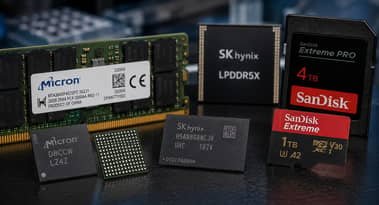
Micron Technology MU shares gained more than 5.9% in trading, while South Korea’s SK Hynix rose 5.6% and SanDisk advanced 8.9%.
Micron has gained more than 730% over the past 12 months, although the stock remains below its summer high of more than $1,200.
US-China tensions boost memory-chip stocks
The latest gains came after Commerce Secretary Howard Lutnick said the Trump administration was discouraging American companies from using Chinese memory chips.
Lutnick told The Wall Street Journal that it was “not great American companies using Chinese memory,” with the administration having conveyed that message to Apple.
The comments follow reports that Apple had held early discussions with ChangXin Memory Technologies, or CXMT, over potentially sourcing components for devices sold in China.
CXMT has expanded rapidly in conventional DRAM and accounted for 7% of the global market by revenue in the second quarter, according to Counterpoint Research.
US rules require American companies to obtain a license before sharing product information with CXMT.
The developments have added another potential tailwind for US memory-chip suppliers as investors return to the AI hardware trade.
BofA sees much stronger earnings ahead for Micron
The bigger catalyst for Micron, however, came from Bank of America, which reiterated its Buy rating and $1,550 price target on the stock.
The target implies roughly 59% upside from the levels cited in the report.
BofA expects Micron’s fiscal 2030 earnings per share to reach between $200 and $250, substantially above Wall Street’s current consensus peak estimate of $160 to $170.
The bank’s bullish forecast is based on its view that memory could be entering a “structurally stronger phase,” rather than experiencing another temporary upcycle.
BofA also considers Micron a top pick, arguing that the company could have significantly greater long-term earnings power than current estimates suggest.
SanDisk is an important part of the bank’s argument. BofA believes SanDisk’s durable growth outlook provides evidence that the broader memory market may be moving toward a more sustained period of strength.
That could mean investors need to look beyond Micron’s near-term results and assess how much earnings power the company could generate over the longer term.
Memory demand remains tight as AI expands
SanDisk CEO David Goeckeler has also pointed to changes in the company’s business model that could reduce its exposure to the memory industry’s traditional boom-and-bust cycle.
Goeckeler said SanDisk is moving toward multi-year customer agreements, increasing demand visibility from roughly three months to more than four years. Between 50% and two-thirds of supply is now covered by agreements, according to his comments.
Micron Chief Business Officer Sumit Sadana separately said customer demand signals have strengthened since the company's latest earnings report. He expects “very tight industry conditions” to continue beyond 2027.
Sadana also highlighted rising demand for high-bandwidth memory as AI workloads expand.
Customers are increasingly identifying DRAM as their primary constraint, ahead of power, real estate, data-center capacity and logic wafers.
The combination of stronger AI demand, tighter memory supply and BofA’s more bullish long-term earnings outlook has provided fresh momentum to memory stocks, although Micron remains below its recent peak.

Jensen Huang sees AGI arriving with OpenAI's Astra: 3 stocks investors should watch

Top FTSE 100 shares to watch: Barclays, Scottish Mortgage, Rolls-Royce

Nike to lose S&P 100 place as stock sinks to 12-year low: what’s ailing NKE?

DAX Index outlook: Top 3 news to move German stocks this week

Why Robinhood stock’s fresh bullish upgrade could be a warning sign
No results found
Loading articles...
Failed to load articles. Please try again.