
S&P 500 record masks $1.5 trillion leverage trap beneath Wall Street’s AI boom

AI Sentiment: 35/100 Bearish
This score is generated through AI-driven analysis of the article's content.

powered by

Buy Microsoft (MSFT) and Alphabet (GOOGL). They’re core AI spend beneficiaries, but unlike pure-play, high-beta AI baskets they have stronger balance-sheet/cash generation and typically face less “crowded trade + margin call” dynamics. If the market sells AI on financing mechanics, these names should hold up better and attract rotation from forced sellers.
Key Risk: A broad risk-off move hits mega-cap tech broadly (rates/credit shock), overwhelming the “quality” cushion and dragging MSFT/GOOGL down with the rest.
Sell/short high-beta AI index exposure: Invesco QQQ (QQQ) and ProShares Ultra QQQ (QLD). The article flags a leverage trap: margin debt at record levels and rapid build-ups mean a normal AI earnings miss can trigger forced selling via collateral calls, not fundamentals. QQQ/QLD are crowded and mechanically sensitive to volatility spikes.
Key Risk: AI earnings and capex guidance stay strong enough that leverage keeps rising without a sharp repricing, so forced-selling never materializes.
- AI leverage is rising as investors crowd into the same high-growth trades.
- Situational Awareness shows how leverage can quickly trigger forced selling.
- Archegos and LTCM show how hidden leverage can magnify broad market shocks.
Leopold Aschenbrenner entered July as one of Wall Street’s most celebrated AI investors.
His hedge fund, Situational Awareness, had returned 439% in the first half of 2026, powered by concentrated bets on the infrastructure behind the artificial intelligence boom.
By the end of the month, that success had turned into a warning.
The fund’s portfolio lost 67% in July after AI-linked stocks reversed sharply. Margin calls followed, and Situational Awareness sold most of its public-equity book to Ken Griffin’s Citadel.
The episode was dramatic, but the more important question is what it says about the market around it.
The S&P 500 closed at a record 7,798.99 on August 13, while investors were borrowing more money than ever against securities portfolios.
FINRA data show debit balances in customer margin accounts reached $1.502 trillion in June, up from $1.008 trillion a year earlier.
Record borrowing does not mean a crash is coming. Margin debt usually rises alongside stock prices, and leverage can remain elevated for long periods.
But when borrowing climbs quickly while investors crowd into similar trades, the mechanics of the next decline can become more important than the reason it started.
That is where the AI rally now faces a less visible test.
A record market with less room for error
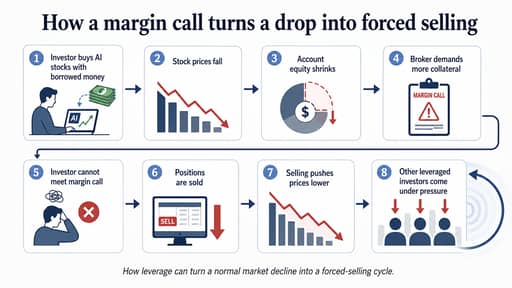
Margin borrowing magnifies returns in both directions. An investor who buys shares partly with borrowed money benefits disproportionately when prices rise.
But a sharp drop erodes the investor’s own capital faster than it reduces the value of the overall position.
When account equity falls below required levels, the broker can demand more collateral.
If the investor cannot provide it, positions may have to be sold, regardless of whether the company’s earnings outlook has changed.
Kate Leaman, chief market analyst at AvaTrade, said the pace of the current build-up matters as much as the record level.
Leaman said the speed of the rise was as important as the record itself, arguing that such rapid increases have appeared in only a handful of late-cycle periods.
She said rapidly rising leverage, combined with the heavy weight of AI and technology stocks in major indices, changes the mathematics of a pullback.
“That doesn't mean a correction is imminent, or that current valuations are unjustified given the scale of AI capital spending underway,” she told Invezz.
“What it does mean is that the market has less cushion than usual to absorb a shock.”
Her key point is mechanical rather than directional. A disappointing earnings report or a cut to capital expenditure guidance could push a heavily owned stock lower.
For an unleveraged investor, that may simply create a paper loss. For a leveraged account, the same decline can create an immediate demand for cash.
“Fundamentals don't get a vote in that process,” Leaman said.
The Federal Reserve has separately warned that hedge-fund leverage remains near all-time highs and is concentrated among a relatively small number of large funds. Its May Financial Stability Report said those exposures span Treasuries, interest-rate derivatives and equities.
The numbers cannot simply be added to FINRA margin debt. They measure different parts of the financial system.
But together they show how much market exposure can depend on financing conditions as well as investment conviction.
AI diversification can disappear when the trade turns
The concentration problem is broader than a handful of mega-cap technology companies.
The AI investment theme now stretches across semiconductors, memory, cloud computing, data centres, electricity generation, networking equipment and even cryptocurrency miners converting power-rich sites into high-performance computing facilities.
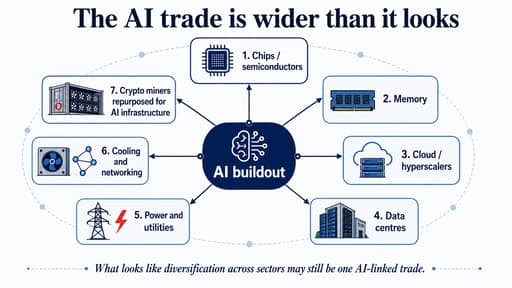
On a spreadsheet, those positions may look diversified. Economically, many depend on the same assumption: that spending on AI infrastructure will remain exceptionally strong for years.
That distinction matters in a sell-off.
If investors suddenly question the pace of AI capital expenditure, a chipmaker, a power supplier and a data-centre landlord can begin trading as different expressions of the same risk. Correlations rise just as funds need diversification most.
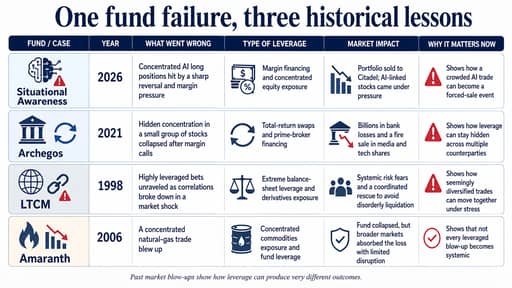
Situational Awareness offered a live demonstration of that vulnerability. The fund gained 439% from the start of 2026 through June before its portfolio lost 67% in July.
It then unwound most of a roughly $16 billion public-equities book, with Citadel buying a large portion.
The sale mattered because it separated two kinds of risk that are often confused.
The first is fundamental risk: whether the AI buildout ultimately earns enough money to justify today’s investments and valuations.
The second is financing risk: whether an investor has enough capital to survive the period before that thesis is proven.
Situational Awareness could not simply wait for every position to recover. Falling asset values collided with leverage and collateral demands.
A longer-term technology view became a short-term liquidity problem.
Archegos showed how the full position can stay hidden
Wall Street has seen this structure before.
Archegos Capital Management collapsed in March 2021 after building enormous concentrated stock exposures through total-return swaps.
The Securities and Exchange Commission later said those instruments allowed the family office to gain large equity exposure while putting up comparatively limited funds.
The positions were spread across numerous counterparties. Each prime broker could see its own relationship with Archegos, but the market did not have a complete view of the fund’s aggregate exposure.
When some underlying shares fell, Archegos faced margin calls it could not meet. Banks started liquidating positions. Those that exited quickly fared better; others suffered billions of dollars in losses.
The direct comparison with today is not that every AI fund resembles Archegos. There is no evidence for that.
The more interesting question is whether many separate hedge funds can collectively recreate the same concentration.
Goldman Sachs, JPMorgan, Morgan Stanley and other prime brokers could each finance clients that appear independent but ultimately own overlapping baskets of semiconductors, power companies, memory producers and data-centre stocks.
In that scenario, no single investor needs to be systemically important. The common trade is what links them.
That is difficult to observe in real time because hedge-fund leverage can sit inside loans, swaps, options and other derivatives.
The Federal Reserve’s warning about near-record hedge-fund leverage therefore matters less as a crash signal than as a reminder that the market’s visible ownership data do not reveal the entire financing structure.
LTCM and Amaranth show two very different endings
Long-Term Capital Management offers another useful precedent.
The hedge fund entered the 1998 crisis with enormous leverage across what appeared to be multiple sophisticated relative-value trades.
When Russia’s debt crisis shook global markets, relationships the fund expected to converge instead moved sharply against it.
Liquidity deteriorated and seemingly distinct positions became correlated. The danger was no longer just LTCM’s losses. A disorderly liquidation threatened to dump large positions into already stressed markets.
Fourteen banks and securities firms eventually supplied $3.6 billion in a private-sector recapitalisation organised with the involvement of the Federal Reserve Bank of New York. The aim was to permit an orderly unwind rather than a fire sale.
But leverage does not always produce systemic contagion.
Amaranth Advisors lost about $6.6 billion in 2006 after a huge natural-gas position moved against it. The fund effectively collapsed, yet markets absorbed the failure with remarkably little disruption.
A Commodity Futures Trading Commission official later noted that the market “barely hiccupped” while digesting the loss.
That contrast matters for the AI debate.
One heavily leveraged fund can fail without taking the market with it if other investors have enough capital, liquidity and willingness to buy its positions.
Situational Awareness may actually support that more reassuring interpretation.
Citadel stepped in as a large buyer. The public-equity portfolio was transferred rather than dumped indiscriminately into the market, and the broader financial system continued functioning.
The episode is a reminder that market resilience is partly a function of balance sheets.
A buyer must exist when a leveraged seller loses the luxury of choosing when, and at what price, to exit a crowded position.
The bullish case: capital is still willing to buy AI
Gil Luria, managing director and senior software analyst at DA Davidson, argues that current leverage does not yet look large enough to turn an AI correction into a systemic event.
“While there is some financial leverage in the system and it is growing, there does not seem to be enough to create more than the type of correction we saw from Situational Awareness and Korean retail,” Luria told Invezz.
His argument rests on the fundamental demand supporting the trade.
Unless AI loses steam and companies and consumers stop using it, the capital markets will likely continue to support the investment in the AI buildout.
That is an important distinction. The AI boom is not built solely on financial speculation. Microsoft, Alphabet, Amazon, Meta and other technology groups are spending heavily on computing infrastructure, while businesses continue experimenting with and deploying generative AI.
As long as investors believe that demand is genuine and durable, sharp declines can attract new buyers. A leveraged seller may be forced out, but a pension fund, sovereign investor or better-capitalised hedge fund can take the other side.
Citadel’s intervention is evidence that such buyers exist.
Mark Hackett, chief market strategist at Nationwide, nevertheless sees reason for caution.
Hackett told Wall Street Journal that investor leverage had reached historic levels across several measures, reflecting what he described as a “lottery mentality” among some retail investors.
He also pointed to the overlap between margin borrowing, options and leveraged exchange-traded funds. These products can create several layers of exposure to the same underlying stocks.
That does not necessarily create the initial shock. It can, however, change what happens next.
One forced seller is manageable, what about several?
The most dangerous scenario begins with an ordinary disappointment.
A hyperscaler cuts its AI capital expenditure forecast. Nvidia issues guidance below the market’s most optimistic expectations, then Data-centre demand slows and Treasury yields rise enough to undermine the economics of financing new infrastructure.
AI stocks fall.
For most investors, that is simply a repricing of future earnings. But for highly leveraged portfolios, falling prices reduce collateral values. Prime brokers can demand more capital or lower exposure.
Funds then sell.
Those sales push prices down further, raising volatility and potentially creating fresh collateral demands elsewhere.
It also does not mean all $1.5 trillion of FINRA margin debt is sitting in AI stocks. FINRA’s aggregate data do not identify the securities being financed or separate retail borrowers neatly from other customers.
And record margin debt by itself has historically been a poor timing tool. Rising markets lift borrowing capacity, so leverage often reaches records when share prices do.
The more useful question is whether leverage is becoming concentrated in the same places where market leadership is already concentrated.
That is why Situational Awareness matters.
Its collapse did not break Wall Street, but showed that the system worked: a forced seller emerged, a stronger buyer absorbed the assets and the market moved on.
In another sense, it provided a glimpse of how quickly conviction can become liquidation when leverage meets a crowded trade.
The S&P 500 can continue setting records while both interpretations remain true.
The next serious test may depend less on whether artificial intelligence changes the economy than on who owns the trade, how much they borrowed to own it, and how many of them are forced to head for the exit at the same time.

Dow closes 500 pts higher as Wall Street rebounds from Treasury yield-driven sell-off

Evening digest: Samsung buybacks rise as Bitcoin, oil rally

Nvidia stock dubbed 'top pick' ahead of Q2 earnings

SpaceX stock rises as Starlink nears 11,000 satellites in orbit

Here’s why the Bloom Energy stock is losing momentum despite its growth
No results found
Loading articles...
Failed to load articles. Please try again.