
Fed Chair Kevin Warsh warns inflation may require more action
AI Sentiment: 25/100 Bearish
This score is generated through AI-driven analysis of the article's content.

powered by

If the Fed stays restrictive longer, rate differentials widen versus Japan, where policy is still far less hawkish. Warsh’s stance supports a stronger dollar and tighter global financial conditions. Buy: long USD/JPY (or USD index vs JPY) to capture FX repricing from “higher-for-longer” US rates.
Key Risk: Japan accelerates its own tightening or risk-off fades and carry unwinds, pushing USD/JPY back down.
Warsh’s message is “more hikes if underlying inflation doesn’t slow.” He says current rates aren’t restrictive enough and summer data isn’t proof of a sustained trend. That keeps the market pricing vulnerable to a hawkish repricing, especially in the front end. Buy: short US 2-year Treasury futures (or buy puts on 2Y notes) to benefit from higher expected policy rates.
Key Risk: Inflation quickly proves durable downtrend (PCE core keeps falling), forcing the Fed to pivot to cuts and crushing front-end yields.
- Fed Chair Warsh warns persistent inflation may require more action.
- Warsh says financial conditions are not broadly restrictive.
- US PCE inflation remains at 3.7%, above the Fed’s 2% target.
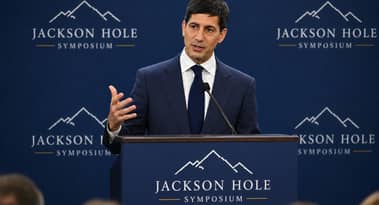
Federal Reserve Chair Kevin Warsh signaled that the US central bank may need to do more to contain inflation, arguing that recent improvements in price data have not provided enough evidence of a sustained slowdown.
In his first speech as Fed chair at the Kansas City Fed’s annual Jackson Hole symposium, Warsh said the central bank must be confident that underlying inflation is moving toward its 2% target at a sufficient pace.
Without that confidence, he said, “we have work to do.”
Warsh stopped short of saying whether he would support a rate increase at the Fed’s September meeting.
Instead, he emphasized that his approach would focus on responding to incoming data rather than signaling specific policy decisions in advance.
The comments come as policymakers remain divided over the appropriate path for interest rates.
Three Fed officials voted for a rate increase at the previous meeting, while others have indicated they could support higher rates.
#KevinWarsh's first #JacksonHole speech as Fed chair, in one line: prices > jobs, and rates aren't even restrictive yet.@realDonaldTrump picked Warsh hoping for a dove, but is he one?
— Invezz (@InvezzPortal) August 28, 2026
Quick breakdown 👇 pic.twitter.com/FApKmoPnY4
Financial conditions remain supportive
Warsh said the current federal funds rate of 3.5%-3.75% does not appear to be placing significant restraint on the broader economy.
Credit and loan markets, he noted, show limited evidence of policy restraint.
Although he acknowledged signs of weakness in areas including housing and agriculture, Warsh said he would be “hard pressed to describe broad financial conditions as restrictive.”
His assessment could strengthen the case for maintaining a restrictive policy stance or potentially raising rates if inflation fails to make further progress toward the Fed’s target.
The debate within the central bank has centered partly on the causes of persistent inflation.
Some policymakers have viewed elevated price pressures as the result of temporary shocks, including tariffs and the Iran war. Others have argued that demand remains strong enough relative to supply to allow businesses to sustain price increases.
Warsh said he had previously favored waiting for additional information before deciding whether a change in interest-rate policy was appropriate, citing potential developments in supply chains, investment and geopolitics.
Inflation remains above Fed target
Recent inflation readings have reduced some pressure for a September rate increase. Market-implied expectations for a hike had fallen below 40% earlier this month after softer readings in June and July.
According to FedWatch data, 55.7% of participants expect a 25-basis-point hike, while 44.3% expect rates to remain unchanged.
Warsh acknowledged that the summer inflation figures were better than expected but said they had not demonstrated a meaningful improvement in underlying trends.
He highlighted the breadth of price increases across the economy. About half of the items in the Fed’s preferred inflation basket are increasing at an annual rate above 3%, compared with roughly one-third during the two decades before the pandemic.
The Personal Consumption Expenditures price index, the Fed’s preferred inflation gauge, is currently running at 3.7%, well above the central bank’s 2% target.
Warsh also said inflation was currently more concerning for policymakers than the labor market, which he described as broadly robust.
The remarks provide the clearest indication yet of Warsh’s approach to monetary policy since taking over as Fed chair.
While he avoided committing to a specific rate decision, his emphasis on persistent inflation leaves open the possibility of further policy tightening if price pressures fail to ease sufficiently.
Fed minutes show several officials favored July rate hike as inflation persists
RBI keeps repo rate unchanged at 5.25% as volatile oil prices cloud inflation outlook
Fed holds rates in 9-3 vote; Warsh says decision not a pause, but a review
ECB leaves rates unchanged as energy prices add to inflation uncertainty

ECB survey signals easing wage and cost growth expectations in Eurozone
No results found
Loading articles...
Failed to load articles. Please try again.