
PayPal stock reels as $53 billion buyout bid from Stripe, Advent unravels: what next?

AI Sentiment: 18/100 Bearish
This score is generated through AI-driven analysis of the article's content.

powered by

Buy PYPL only if you can get it after a flush near $40–$42. The thesis is that the market is over-discounting the turnaround timeline: Venmo Debit MAUs +50% and Pay With Venmo +30% show a real growth pocket. If Lores delivers cost cuts ($1.5B savings by 2027) and improves marketing efficiency/AI, the stock can rebound on “proof of execution,” especially if buybacks resume with any Venmo monetization narrative. Key risk: Venmo growth slows materially and cost cuts don’t translate into higher earnings power.
Key Risk: Venmo’s growth decelerates and cost cuts fail to lift earnings, so the stock stays a low-growth value trap.
Sell PYPL. The $50B bid collapse removes a major catalyst and leaves only a slow-growth turnaround: revenue +5% and EPS -3% recently, with estimates still stuck around low-single-digit growth. Technicals also warn of downside (rising wedge + bearish RSI/MACD divergence), with $40.45 the next support if momentum breaks. Key risk: Venmo spin-off (or a credible alternative) unlocks a sharp re-rating and accelerates growth expectations fast enough to offset the bid failure.
Key Risk: A Venmo separation/turnaround plan convinces the market growth is re-accelerating, driving a re-rating that overwhelms the technical downside.
- PayPal stock is crashing today as the acquisition bid by Stripe and Advent stalled.
- The company’s management faces substantial challenges turning around the company.
- The stock was forming a bearish divergence pattern before the report.
PayPal stock suffered a sharp reversal in premarket trading after Stripe and Advent abandoned their much hyped bid to acquire the company. PYPL fell to $53, a decline of nearly 15% from its high this month. The retreat could deepen further as PayPal continues to grapple with substantial challenges.
Stripe and Advent abandon PayPal bid
PayPal stock plunged after reports emerged that Stripe and Advent decided to drop their acquisition bid for the company. The two firms had made a $50 billion bid for the company.
While the amount was a huge one, it would have sealed the company’s fall from grace as its market capitalization peaked at over $300 billion during the pandemic.
Therefore, the developments means that PayPal will now need to execute a good turnaround strategy, something that has been difficult in the past few years.
The most recent results showed that its revenue growth has stalled. PayPal’s last results showed that its revenue rose by 5% in the second quarter to $8.7 billion, with its earnings-per-share (EPS) falling by 3% to $1.25. In contrast, the average earnings growth for the S&P 500 Index was 50.4% in the second quarter.
PayPal’s growth has stalled in other metrics. For example, its monthly active users rose by 1% to 228 million, while the number of transactions per active account rose by just 3%.
Most notably, analysts expect the earnings growth to remain under pressure in the near term. The average estimate is that its annual revenue will grow by 4.6% this year to $34 billion. This slowdown is expected to grow by 4.38% to $36.23 billion.
The same is happening with its earnings growth, with the EPS expected to grow to $5.39 this year followed by $5.79 next year. These metrics suggest that the company is no longer growing as it used to in the past.
What next for PayPal?
PayPal’s new CEO, Enrique Lores, faces a major challenge turning around the company, something that his predecessor failed in. One approach is to focus on Venmo, the fastest-growing part of its business.
Some analysts believe that the company would do well by spinning Venmo off. In its last results, the company said that its Venmo Debit Card’s monthly active accounts rose by over 50%, while Pay With Venmo rising by over 30%. Spinning it off would help it generate strong cash, which it can use to intensify its buyback or add its dividends. PayPal can also use the funds to execute quality to acquire companies to reinvigorate its revenue growth.
In his recent statement, Lores highlighted several turnaround strategies, including cutting costs. He expects to cut organizational layers, targeting $1.5 billion in savings through 2027. He also committed to improving marketing efficiency, and integrating AI into the platforms.
PayPal stock technical analysis
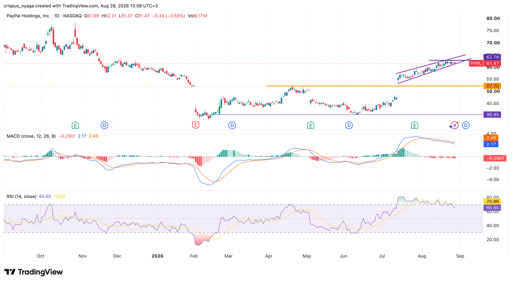
PYPL stock chart | Source: TradingView
The daily chart suggests that the PYPL stock has been signaling a potential retreat in the past few weeks. It formed a rising wedge pattern, which is made up of two ascending and converging trendlines. The Relative Strength Index (RSI) has formed a bearish divergence pattern.
The MACD indicator also formed a bearish divergence pattern. Therefore, there is a risk that the stock will remain under pressure in the coming months. If this happens, the stock will likely drop to the key support level of $40.45, its lowest level in June.

Marvell stock sinks 8%: is its $120B Google deal taking too long to pay off?

Nvidia, AMD, Intel stocks slide premarket: why investors are suddenly taking profits

Micron stock has surged 220%: here’s the risk bulls may be underestimating

Nikkei 225 catches Nvidia’s tailwind, but KOSPI finds a reason to sell instead

Samsung stock retreat again: why a massive payout isn’t enough for investors
No results found
Loading articles...
Failed to load articles. Please try again.