
USD/JPY signal: forecast as a death cross forms ahead of key US, Japan macro data

AI Sentiment: 15/100 Bearish
This score is generated through AI-driven analysis of the article's content.

powered by

Buy JPY versus high-yield funding: long JPY (e.g., buy USD/JPY puts or simply long JPY against USD). The thesis is that a BoJ rate rise narrows the US–Japan yield gap and forces investors to unwind carry positions. With death-cross technicals, the unwind can accelerate into the macro prints.
Key Risk: US inflation stays hot and Fed stays hawkish enough to widen the yield gap again, pulling money back into USD carry and reversing JPY strength.
Sell USD/JPY (target 152.10). The yen is already in a strong uptrend, the pair broke below 154.97 support, and a death cross is forming—momentum favors further downside. The catalyst stack (BoJ hike odds ~98%, Japan GDP, then US PPI/CPI) keeps the market leaning toward tighter Japan policy and less carry demand.
Key Risk: BoJ disappoints (no hike or dovish guidance), causing USD/JPY to snap back above 154.97 and unwind the death-cross momentum.
- The USD/JPY pair has crashed to the lowest level since February.
- Japan will publish the latest GDP numbers on Tuesday this week.
- The US will release the latest producer and consumer inflation reports.
The Japanese yen is in a strong uptrend this week, reaching its highest level since February this year. The USD/JPY pair dropped to 154.28, down by nearly 6% from its highest level this year. This retreat will be put to the test ahead of major macro events in the next two weeks.
Odds of BoJ interest rate rise ahead of Japan GDP data
The USD/JPY exchange rate has crashed hard in the past few days, helped by the rising optimism that the Bank of Japan (BoJ) will hike interest rates next week. A Polymarket poll places the possibility that the bank will do that next week at 98%.
The bank is hiking rates for two main reasons. First, Japanese inflation remains stubbornly high in Japan’s standards. The most recent data showed that the country’s consumer price index (CPI) jumped 1.9% in July. More data revealed that inflation has continued rising in the past few months.
Second, the BoJ aims to narrow the spread with the United States, which has widened in the past few years. By doing that, the bank aims to make the Japanese yen more attractive to investors, ending the carry trade opportunity.
The USD/JPY pair has also dropped as investors predicted that the BoJ will intervene monetarily. It has already spent billions of dollars defending the yen in the past few months, including with the help of the United States.
The next key catalyst for the USD/JPY pair will be the upcoming Japan GDP numbers, which will come out on Tuesday. Economists expect the data to show that Japan’s economy expanded by 0.3% in the second quarter after growing by 0.5% in the previous quarter.
US inflation report
The next important catalyst for the USD/JPY exchange rate is the upcoming macro data from the United States, where the Bureau of Labor Statistics (BLS) will publish the latest consumer and producer inflation report.
The first report to watch will be the PPI, which will come out on Thursday this week. Economists expect the report to show that the PPI rose from 0% in July to 0.4% in August, while the core figure rose from 0.2% to 0.3%.
After that, the US will release the consumer inflation number on Friday, shedding light on the state of inflation in the country. These numbers will provide more hints on what to expect from the Federal Reserve next week.
USD/JPY forecast: technical analysis
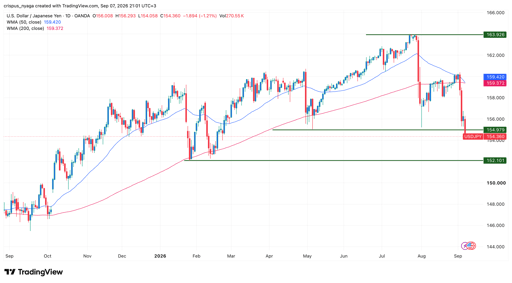
USDJPY chart | Source: TradingView
The daily chart shows that the USD/JPY exchange rate has plunged in the past few days. It has moved from a high of 163.92 in July to a low of 154.3. It moved below the important support level of 154.97, its lowest level in May and August this year. Moving below that price confirmed the bearish breakout.
Most notably, the pair has formed a death cross pattern as the 50-day and 200-day weighted moving averages crossed each other. Therefore, the pair will likely continue falling, potentially to the key support level of 152.10, its lowest level in January.

SDV's Alexander Lis on why the Debasement trade is more complicated than it looks

Lloyds share price forms a risky pattern as insiders sell, risky pattern forms

Vodafone share price: Technicals point to a jump to 135p as turnaround continues

Top FTSE 100 shares to watch: Barclays, Scottish Mortgage, Rolls-Royce

Here’s why Bittensor (TAO), Near Protocol, and Venice Token rising
No results found
Loading articles...
Failed to load articles. Please try again.