
Nvidia supplier Wistron is spending big on AI: why is the stock falling?
AI Sentiment: 35/100 Bearish
This score is generated through AI-driven analysis of the article's content.

powered by

Buy Wistron. The selloff is driven by a discounted global share sale and ~7% dilution, not collapsing AI demand—management says AI server demand still exceeds supply and revenue/profit are accelerating. The capital raise is largely to fund working capital and expensive components needed to scale production, which should translate into higher shipments as hyperscalers keep ramping AI. Key upside catalyst: margins and cash conversion holding up as the Fort Worth GB300 build ramps.
Key Risk: AI server growth slows or margins/cash conversion deteriorate, so the dilution isn’t offset by incremental earnings.
Buy Taiwan semi equipment/parts exposure via ASML (ASML) and Applied Materials (AMAT). The news confirms the AI buildout is still in full swing at the supplier level (factories, GPUs, memory, networking). Even if Wistron’s stock dips, the broader capex cycle for AI infrastructure continues, supporting demand for semiconductor manufacturing tools and upgrades.
Key Risk: AI capex pauses at hyperscalers or semiconductor equipment demand weakens, cutting orders before the supply chain catches up.
- Wistron raises $1.47 billion as AI server demand drives expansion spending.
- Discounted GDR sale dilutes shareholders by about 7.3% amid rapid expansion.
- AI server growth stays strong, but margins and cash conversion now matter.
Wistron’s AI server business is booming, but investors are being reminded that rapid growth comes with a price.
The Nvidia supplier is raising about $1.47 billion through a global share sale, issuing 25 million global depositary receipts representing 250 million new ordinary shares.
The deal was priced at $58.88 per receipt, equivalent to about NT$186.24 per share and a 5.5% discount to Wistron’s September 7 close.
That will dilute existing shareholders by about 7.29%, while the proceeds will largely fund purchases of raw materials in foreign currencies.
Wistron shares slumped about 5% in Tuesday trading, extending Monday’s 0.5% decline as investors reacted to the discounted share sale and resulting dilution.
The stock had jumped 5% in the previous session and remains up strongly this year.
The immediate problem is dilution, not weak AI demand
For investors, the short-term concern is straightforward. Wistron is creating more shares, meaning existing shareholders will own a smaller percentage of the company after the transaction.
New investors are getting exposure at about NT$186.24 a share, below Monday’s NT$197 close. That can pressure the existing stock as the market adjusts to the cheaper issuance price.
JPMorgan noted that Wistron has a “robust AI order outlook”, but said the GDR issuance would create roughly 7% dilution as the company supports growing working-capital needs.
The bank still upgraded the stock to Overweight from Neutral and set an NT$260 target.
Wistron must buy expensive GPUs, memory, networking equipment and other components before customers ultimately pay for finished systems.
As production scales, more cash becomes tied up in inventory and operations.
Nvidia’s AI boom is forcing Wistron to spend first
Wistron is not raising money because demand is deteriorating.
In August, the company said AI server demand from cloud-computing and enterprise customers continued to exceed supply. Second-quarter revenue climbed 64% from a year earlier, while net profit jumped 128%.
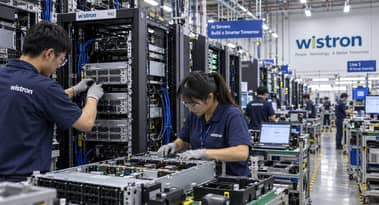
In July, it opened a $700 million facility in Fort Worth, Texas, where Nvidia’s GB300 Grace Blackwell Ultra systems are being manufactured. The company has approved additional expansion spending in Taiwan.
Morgan Stanley remains bullish on Wistron’s expansion despite the near-term funding pressure.
TechNews reported in August that the bank expects Wistron’s AI-server momentum to continue at least through the first half of 2027, helped by existing customers, new cloud-service-provider business and additional platforms including AMD’s MI400 series.
Morgan Stanley raised its price target to NT$275 from NT$210 and maintained an Overweight rating.
Can AI growth outrun the dilution?
The longer-term question is whether the capital Wistron is raising produces enough additional profit to offset the larger share count.
Industry conditions remain supportive. TrendForce said in August that hyperscale cloud providers were ramping AI spending, lifting server shipments, while Wistron and other manufacturers expanded GPU-rack fulfilment.
The research firm forecasts global AI server shipments to rise nearly 31% in 2026.
But stronger revenue alone will not settle the debate.
Wistron is committing large sums to factories, inventories and expensive components. It also operates in a business where powerful hyperscale customers can influence pricing and margins.
If AI-server sales expand without a corresponding improvement in profitability, shareholders could absorb dilution without receiving enough incremental earnings in return.
That makes margins and cash conversion increasingly important alongside shipment growth.

Why investors see more upside for SanDisk's 500% rally
DRAM ETF gained 18% last month: can it continue its outperformance

UBS sees two Fed hikes in 2026: what should investors buy

Broadcom stock: Why the AI chipmaker’s growth story is gaining steam

Is Oracle stock a buy before earnings as analysts turn bullish?
No results found
Loading articles...
Failed to load articles. Please try again.