
Explained: US-Iran 14-point peace plan MoU
AI Sentiment: 72/100 Bullish
This score is generated through AI-driven analysis of the article's content.

powered by

Buy: Long Brent (or WTI) futures. The MOU commits to reopening the Strait of Hormuz with safe, toll-free passage for 60 days and restoring traffic levels within 30 days, directly cutting the war “shipping risk” premium. Also, US waivers are set to enable Iranian crude/petroleum flows once implemented, tightening the supply outlook versus a prolonged disruption scenario.
Key Risk: Israel keeps escalating on Lebanon/Hezbollah, forcing renewed strikes that shut or endanger Hormuz traffic again.
Buy: Frontline/Teekay-type tanker exposure (e.g., Frontline Ltd. (FRO) or Teekay Tankers (TNK)). Second-order: if Hormuz traffic normalizes and Iranian barrels return via waivers, tanker utilization and freight rates should improve first, before crude prices fully reflect the new flow. That front-runs the broader energy sentiment move.
Key Risk: Drone/attack reports near commercial vessels persist, keeping insurers and shippers cautious and preventing utilization from rising.
- US-Iran 14-point MOU opens path to ceasefire and final talks.
- Deal covers sanctions, oil waivers, frozen assets and nuclear terms.
- Hormuz reopening could ease shipping risks and oil-market pressure.
The United States and Iran have signed a 14-point memorandum of understanding aimed at halting more than 100 days of war and reopening the Strait of Hormuz.
The agreement gives both sides 60 days to negotiate a final deal on the hardest issues, including sanctions, nuclear restrictions and frozen assets.
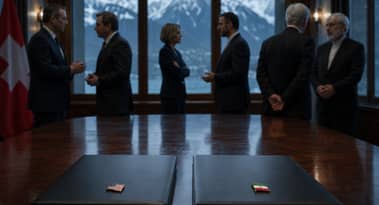
Israel is not a party to the MoU, and its refusal to be bound by the Lebanon provisions leaves a major enforcement gap before Friday’s planned ceremony in Bürgenstock, Switzerland.
What are the 14 points of the MoU?
- War termination – US, Iran and allies agree to permanently end hostilities on all fronts, including Lebanon, and guarantee Lebanese sovereignty.
- Mutual respect – Both sides commit to respecting each other's sovereignty and staying out of each other's internal affairs.
- 60-day clock – Final deal negotiations to wrap within 60 days, extendable by mutual agreement.
- Naval blockade lifted – US starts removing its naval blockade immediately, fully ends it in 30 days, and pulls forces back after the final deal.
- Strait of Hormuz reopened – Iran clears safe, free passage for commercial vessels through the Strait within 30 days, with future maritime administration discussed alongside Oman and Gulf states.
- $300 billion reconstruction plan – US and regional partners commit to a minimum $300 billion rebuild-and-development package for Iran, mechanism finalised within 60 days.
- Sanctions rollback – US agrees to lift all UN, IAEA and unilateral sanctions on Iran per a schedule set in the final deal.
- No nukes, stockpile resolved – Iran reaffirms no nuclear weapons; enriched stockpile to be down-blended under IAEA watch, with enrichment rights to be hashed out later.
- Status quo freeze – Until the final deal, Iran holds its nuclear program steady while the US adds no new sanctions or troops.
- Oil exports waived – US Treasury to issue immediate waivers letting Iran export crude, products and related services (banking, insurance, shipping).
- Frozen assets unlocked – The US commits to freeing up Iran's frozen funds for use, with release procedures and licenses to follow.
- Compliance watchdog – An executive mechanism will be set up to monitor the MOU's implementation and the eventual final deal.
- Implementation triggers talks – Once paragraphs 1, 4, 5, 10 and 11 start being implemented, full negotiations on the remaining issues begin.
- UN seal of approval – The final deal gets locked in via a binding UN Security Council resolution.
A ceasefire that still leaves Israel outside the tent
The first clause of the MoU calls for the “immediate and permanent” termination of military operations on all fronts, including Lebanon.
It also commits Washington and Tehran to respect each other’s sovereignty and avoid the threat or use of force.
That sounds sweeping, but the wording is already being tested. Israel has made clear it is not a signatory to the US-Iran arrangement.
Prime Minister Benjamin Netanyahu has said Israel will keep its forces in southern Lebanon and preserve freedom of action against Hezbollah.
That caveat matters because Lebanon is one of the agreement’s most sensitive pressure points.
Reuters quoted Dan Shapiro, a former US ambassador to Israel and now an Atlantic Council fellow, as saying this was “a pretty stark moment of divergence of interests”.
He added that Netanyahu was likely to signal that Israel was not bound by the agreement and would reserve its rights.
The result is a ceasefire framework with immediate market significance, but not yet a regional settlement.
It can reduce direct US-Iran confrontation, but it cannot by itself stop every front linked to the war.
Sanctions, frozen assets and oil relief come with sequencing risk
The economic bargain is the core of the MOU. The US commits to working with regional partners on a reconstruction and development plan worth at least $300 billion.
It also pledges to terminate sanctions on an agreed schedule as part of the final deal.
The crucial point is timing. Broad sanctions termination is not immediate. It is tied to negotiations over the next 60 days.
However, the MOU says the US Treasury will issue waivers for Iranian crude oil, petroleum products and related banking, insurance and transport services once the agreement is implemented.
That is why oil traders reacted quickly, as any return of Iranian barrels, combined with a reopening of Hormuz traffic, changes the supply outlook for crude markets.
Brent and WTI have already eased as investors price out some of the war premium.
Frozen assets remain more contested. Iran has pushed the argument that restricted funds should become available under the MOU.
Washington is trying to frame any release as conditional and sequenced.
US Vice President JD Vance said that no funds had been released for signing the deal.
The tension is central to the next phase. Tehran wants early economic benefits to prove the deal has value.
Washington wants verification first, especially on enriched uranium and nuclear monitoring.
Also read: Hormuz reopening lifts sentiment, but analysts see months before trade recovery
Hormuz reopens, but the nuclear question is unresolved
The Strait of Hormuz is the clearest near-term market channel. Iran has agreed to use its best efforts to ensure safe, toll-free passage for commercial vessels for 60 days.
It also commits to restoring traffic levels within 30 days, while later talks with Oman and Gulf states would address longer-term maritime administration.
That is a major relief signal for energy markets. The strait is one of the world’s most important oil chokepoints, and the war had turned shipping risk into an inflation risk.
Still, the reopening narrative is not risk-free as reports of drone activity near commercial vessels after the MOU undercut the idea that shipping conditions have already normalised.
The nuclear language is even more fragile. Iran reaffirms that it will not procure or develop nuclear weapons, but that is not a new concession in itself.
The MOU says the sides will resolve the stockpile of enriched material through a mutually agreed mechanism, with down-blending on site under IAEA supervision as the minimum method.
The harder question, whether Iran retains enrichment rights and under what limits, is left for the 60-day talks.
That makes the MOU a de-escalation document, not a nuclear settlement.
The immediate takeaway for markets is lower tail risk around Hormuz and Iranian oil exports.

Hang Seng Index: Top 3 reasons Hong Kong stocks are falling today

Kospi Index at a crossroads as Samsung, SK Hynix leverage bets reverse

Rolls-Royce stock: The bull case is strong, but these risks could trigger a drop

Here’s why the Alibaba stock is crashing in Hong Kong today
Here’s the top reasons why the Kospi Index is falling today
No results found
Loading articles...
Failed to load articles. Please try again.