
Kospi Index at a crossroads as Samsung, SK Hynix leverage bets reverse
AI Sentiment: 22/100 Bearish
This score is generated through AI-driven analysis of the article's content.

powered by

Buy Samsung Electronics (005930.KS). The news says buybacks/dividends are huge ($80B) and leverage trading is collapsing (leveraged volume down to ~4% of June peak). That combination usually forces selling pressure to fade while fundamentals stay supported by capital returns. Also, the index is near a technical support zone (6,000), which often triggers bargain demand in the biggest AI beneficiaries.
Key Risk: A renewed risk-off move that drags the stock down despite buybacks—especially if Korea inflation stays hot and the central bank hikes again.
Buy SK Hynix (000660.KS). Same setup: massive capital returns (~$30B) plus leveraged-trader unwind (first monthly outflows). When leverage unwinds, the stock often rebounds faster than the index because forced selling stops. SK Hynix is also a direct beneficiary of data-center memory demand, so any stabilization in macro prints can quickly re-rate the name.
Key Risk: Memory demand breaks (AI/data-center capex slows) or export numbers disappoint enough to crush the earnings outlook.
- The Kospi Index has pulled back into a bear market.
- Leveraged bets on Samsung Electronics and SK Hynix have plunged.
- Technicals suggest that the index may be on the cusp of a bearish breakout.
The Kospi Index has come under intense pressure in the past few months as top constituents like Samsung Electronics and SK Hynix lost momentum and as wary South Koreans pare back their leveraged bets. It dropped to 6,788 on Friday, down by 27% from its highest point this year.
South Koreans ditch their leveraged bets
The Kospi Index embarked on one of the best bull runs since 2025 when the new president pledged to push it to the 5,000 mark. His statement coincided with the artificial intelligence boom that led to a surge in data center spending in the US and other countries.
The boom led to a surge in demand for products made by companies like Samsung and SK Hynix. Indeed, the two companies have recently released strong financial results and announced a significant increase in share buybacks and dividends.
Samsung will spend $80 billion in buybacks, while SK Hynix will spend nearly $30 billion. Despite this, the two stocks have dropped by 32% and 44% from their highest levels this year.
This trend pushed more South Koreans to embrace leveraged bets in South Korean stocks. Most notably, the decision to allow leveraged stock trading led to a frenzy.
Now, however, there are signs that this trend is reversing as South Koreans lost billions of dollars. According to Bloomberg, the volume of leveraged Samsung and SK Hynix traded has dropped to 4% of the June peak.
They are also set to have the first monthly outflows since they were approved. This action is mostly because of the ongoing regulatory tightening and the losses traders experienced as the two stocks dropped. This performance has led to a sharp decline in Kospi’s volatility.
Key South Korean data ahead
The Kospi Index also wavered after the South Korean Central Bank decided to hike interest rates last week. It hiked rates for the second consecutive meeting, citing the elevated inflation. This inflation has been caused by the US-Iran war and the soaring wages in Samsung, SK Hynix, and their suppliers.
There will be some important macro numbers later this week. On Monday, South Korea will release the latest retail sales and industrial production numbers, which will shed color on the state of the economy. Analysts expect these numbers to show that retail sales and industrial production rose in July.
The other key macro data to watch will be South Korea’s exports and imports numbers. Economists expect the report to show that exports jumped by 62.6% in August, while imports jumped 24.7%, leading to a trade surplus of over $30.7 billion.
The Kospi Index will also react to the latest consumer inflation report on Wednesday. That report will help to determine whether the central bank will hike interest rates again.
Kospi Index technical analysis
Kospi Index chart | Source: TradingView
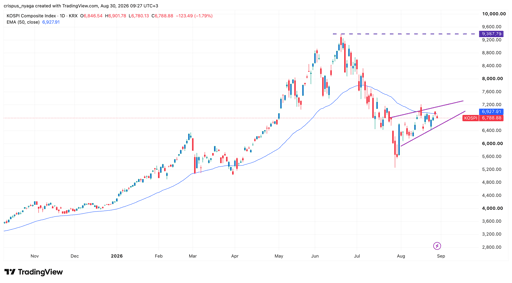
Technicals suggest that the Kospi Index is at risk of more downside in the near term. It has slowly formed a rising wedge pattern, a common bearish reversal sign. This wedge is forming after it dropped sharply from the all-time high of 9,387. As such, there are signs that this is a bearish flag pattern.
The index remains below the 50-day Exponential Moving Average, a sign that bears are in control for now. Therefore, the most likely scenario is where it drops to the key support level of 6,000 points.

How Meta’s $18B teen safety settlement could reshape social media regulation

Nvidia is using its balance sheet to fuel the AI boom. Is it a double-edged sword?

Dow holds weekly gain as Warsh inflation warning lifts rate hike bets

Workday stock jumps 5% after earnings beat, but analysts split on AI growth outlook

Evening digest: Warsh signals inflation fight, gold and oil slide
No results found
Loading articles...
Failed to load articles. Please try again.