
Why is Archer Aviation's stock jumping 18% today?
AI Sentiment: 72/100 Bullish
This score is generated through AI-driven analysis of the article's content.

powered by

Buy Archer Aviation (ACHR). The Anduril partnership turns the story from “urban air taxi optionality” into a dual-use platform with defense relevance, plus hybrid-electric performance targets (range/payload) that can unlock bigger missions than pure battery eVTOL. The stock already priced in heavy skepticism (down 36% YTD), so a credible path to commercial partners “later this week” can drive another leg higher.
Key Risk: Defense and commercial customers don’t sign real contracts, leaving Thunder as mostly announcements with no revenue before 2027.
Buy a defense-prime proxy (e.g., Lockheed Martin (LMT) or Northrop Grumman (NOC)). If Archer’s platform gains traction, it pulls vertical-lift autonomy into defense procurement ecosystems, increasing demand for integration, sensors, mission systems, and production capacity—benefiting established primes even if Archer’s timeline slips.
Key Risk: The Thunder program fails to progress beyond prototypes, so primes see no meaningful procurement or integration work tied to it.
- Archer Aviation shares climbed over 18% after unveiling a new autonomous VTOL platform developed with defense startup Anduril.
- The hybrid-electric aircraft will support military, cargo and commercial missions.
- The partnership expands Archer beyond the urban air taxi market as eVTOL makers diversify into defense and logistics.
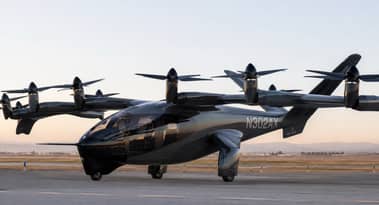
Shares of Archer Aviation ACHR surged more than 18% on Monday after the electric vertical takeoff and landing (eVTOL) aircraft maker unveiled a new autonomous aircraft platform developed jointly with defense technology company Anduril Industries, marking a major expansion beyond its core urban air mobility business.
The companies introduced a dual-use hybrid-electric vertical lift platform designed to serve both military and commercial customers, as eVTOL manufacturers increasingly seek new revenue streams amid slower-than-expected progress in the air taxi industry.
As part of the partnership, Anduril showcased the defense version of the platform, called Thunder, a Group 5 autonomous attack rotorcraft designed to enhance the capabilities of current and next-generation crewed military aircraft.
According to a joint statement, Thunder is based on a common aircraft platform jointly developed by Archer and Anduril.
"Together, the two companies have built what they believe to be a step change in vertical lift: a new class of autonomous aircraft with the speed, range, payload and operating cost that defense and commercial missions demand," the companies said.
The platform is intended to support a broad range of applications, including military strike missions, cargo transportation, remote logistics and operations from austere environments.
Archer said it plans to announce its first commercial partners for the aircraft later this week.
The announcement comes as developers of electric aircraft diversify into defense, logistics and cargo operations to offset certification delays, infrastructure challenges and high capital requirements that have clouded the outlook for urban air taxi services.
Hybrid-electric design targets broader markets
Unlike Archer's existing electric air taxi aircraft, the newly unveiled platform uses a series hybrid-electric propulsion system designed to deliver greater range and payload capacity.
The aircraft also incorporates tilt rotors capable of adjusting rotor speeds across different phases of flight, allowing it to perform a wider variety of missions than conventional battery-powered eVTOL aircraft.
Developers across the industry have increasingly shifted toward hybrid-electric systems as they attempt to overcome the limited range of fully electric aircraft and access larger commercial and defense markets.
The companies said they have already completed multiple test flights using full-scale surrogate aircraft to validate key systems, while Thunder's first flight is currently scheduled for 2027.
Defense market offers new growth opportunity
For Archer, the collaboration represents an important strategic move into defense and industrial applications at a time when the commercial air taxi market remains uncertain.
Urban air mobility was once viewed as a potential trillion-dollar opportunity, but certification timelines, infrastructure development and funding challenges have slowed the industry's commercial rollout.
Many eVTOL manufacturers are now pursuing defense contracts and cargo operations that could generate revenue sooner and require less extensive urban infrastructure.
Shane Arnott, senior vice president of Maneuver Dominance at Anduril, said adapting commercial aviation technology for military use could significantly improve operational capabilities.
"From raw performance to producibility, harnessing the best technologies from the commercial eVTOL market for defense is central to how Thunder will deliver operational value to our customers. The clean-sheet, dual-use platform that we've built with Archer truly represents a step change in capability," Arnott said.
Archer founder and CEO Adam Goldstein said the project required an entirely new aircraft rather than adapting the company's existing designs.
"This mission required a clean sheet design, built from the ground up to meet the needs of modern commercial and defense applications. We couldn't simply tweak our existing aircraft. Instead, we took a bold first principles approach alongside Anduril to develop what we believe is the most sophisticated vertical lift aircraft ever made," Goldstein said.
Analysts remain divided on Archer shares
Monday's rally came despite mixed views from Wall Street on Archer's long-term prospects.
Weiss Ratings recently reaffirmed a "sell (D-)" rating on the stock, while Canaccord Genuity trimmed its price target to $12 from $13 but maintained a "buy" recommendation.
According to MarketBeat data, four analysts currently rate Archer Aviation as a Buy, two recommend Hold and one has a Sell rating, giving the stock an overall consensus rating of Hold with an average price target of $11.83.
The stock currently trades at $5.20, and has fallen 36% this year.

Kospi Index at a crossroads as Samsung, SK Hynix leverage bets reverse

How Meta’s $18B teen safety settlement could reshape social media regulation
Nvidia is using its balance sheet to fuel the AI boom. Is it a double-edged sword?

Dow holds weekly gain as Warsh inflation warning lifts rate hike bets

Workday stock jumps 5% after earnings beat, but analysts split on AI growth outlook
No results found
Loading articles...
Failed to load articles. Please try again.