
PI price faces a fresh breakdown as $0.096 resistance proves too strong

AI Sentiment: 42/100 Bearish
This score is generated through AI-driven analysis of the article's content.

powered by

Buy Pi Network (PI) for a technical bounce. The article flags weakening sell pressure (MACD rising, RSI ~45 toward 50) while derivatives open interest stays stable, meaning traders aren’t fleeing. The trigger is a daily close back above $0.0961; that should open a push toward $0.10, with upside to $0.1183 if momentum follows through.
Key Risk: A daily close back below $0.0950, proving the bounce failed and sending PI toward the $0.0700 low.
Sell/short Pi Network (PI) if it fails the $0.0961 test. The token is still below the key resistance and the broader structure remains mildly bearish; overhead supply has repeatedly capped recoveries at this level. If price stalls under $0.0961, expect sellers to reassert control and drive a move back toward $0.0950 support, then lower.
Key Risk: PI breaks and holds above $0.0961 (and especially above $0.10), forcing shorts to cover and invalidating the rejection thesis.
- PI is below $0.1000 psychological level and faces resistance at $0.0961.
- Broader Crypto Fear and Greed Index has recovered to 40 in recent days.
- A sustained break above $0.0961 could send PI toward $0.1183.
Pi Network (PI) extended its losses on Monday following a bearish close during the previous session.
The token remains below the $0.1000 psychological threshold as sellers continue to defend the nearby resistance at $0.0961.
Although derivatives demand is holding steady and broader cryptocurrency sentiment is improving, PI’s technical structure retains a mildly bearish bias.
Momentum indicators suggest that selling pressure is gradually weakening. However, PI must reclaim $0.0961 before a more meaningful recovery can begin.
Crypto market sentiment begins to improve
The broader cryptocurrency market is showing early signs of a recovery in risk appetite.
CoinMarketCap’s Crypto Fear and Greed Index stands at 40, reflecting a move away from the Fear zone and toward neutral territory.
An improving sentiment reading can support speculative assets such as Pi Network by encouraging traders to increase their exposure.
However, a value of 40 still indicates that market participants remain cautious rather than decisively bullish.
PI will likely need stronger demand across the broader crypto market to overcome its immediate technical barriers.
Speculative demand for Pi Network remains stable despite its recent price weakness. CoinAnk data shows that PI futures Open Interest stands at $9.26 million.
The metric has remained above $9 million for the past six days, indicating that traders continue to maintain their positions.
Open Interest measures the total value of outstanding futures contracts that have not been settled. Its stability suggests that speculative participation has not collapsed during the latest decline.
However, the relatively low value compared with larger cryptocurrency markets indicates that PI continues to attract limited derivatives activity.
Stable Open Interest alongside improving market sentiment creates a mildly positive backdrop, but stronger capital inflows would be required to support a sustained breakout.
Pi Network faces resistance at $0.0961
Pi Network remains within a broader bearish structure while trading below the 127.2% Fibonacci extension level at $0.0961.
The Fibonacci level is calculated from the decline between $0.1998 and $0.1183 and has repeatedly limited PI’s recent recovery attempts.
The token edged lower on Monday after failing to overcome this barrier, reaffirming the strength of overhead selling pressure.
A sustained daily close above $0.0961 would weaken the immediate bearish outlook and place the psychological $0.1000 level back within reach.
Pi Network’s momentum indicators show that bearish pressure is beginning to fade. The Moving Average Convergence Divergence line is above its signal line and continues to rise while remaining in negative territory.
This setup indicates that downside momentum is weakening, although it does not yet confirm a complete bullish reversal.
The Relative Strength Index stands near 45 and is approaching its neutral midpoint of 50. A move above the midline could signal that buyers are beginning to gain control.
Together, the MACD and RSI suggest that PI has room to recover if it can attract sufficient buying pressure around current levels.
PI must first record a decisive break above the $0.0961 resistance level to strengthen its recovery prospects.
Clearing this barrier could allow the token to retest the psychological threshold at $0.1000. A sustained move above $0.10 would improve market confidence and potentially extend the rally toward the Fibonacci anchor at $0.1183.
The move from $0.0961 to $0.1183 would represent a recovery of approximately 23%. However, Pi Network’s limited speculative demand and broader bearish structure could make it difficult for buyers to sustain such a move without an increase in trading volume and Open Interest.
On the downside, the previously broken descending trendline near $0.0950 provides Pi Network’s immediate support.
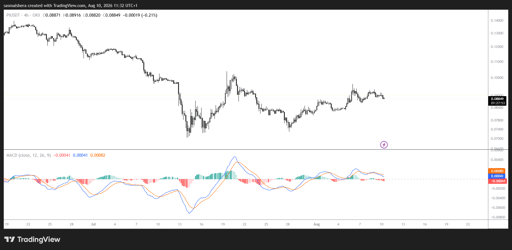
Holding above this area would keep the short-term recovery attempt intact and give buyers another opportunity to challenge the $0.0961 resistance.
A decisive close below $0.0950 could invalidate the recent trendline breakout and increase selling pressure. In that scenario, the record low around $0.0700 would become the main downside target.
For now, Pi Network remains caught between improving momentum and firm resistance. Reclaiming $0.0961 is essential for confirming a recovery toward $0.10 and potentially $0.1183.

Bitcoin reclaims $80K as Fed rate-hike odds fall on Fed Governor's comments

Can Bitcoin price reach $80,000 after its latest breakout?

Flowra, KorDA sign MOU to explore gold-backed Solana validator infra

Bahrain leads the Middle East stablecoin race, but where are the coins?

Could ADA rip past $0.21 as Cardano governance turns from risk to catalyst?
No results found
Loading articles...
Failed to load articles. Please try again.