
Here’s why the Nikkei 225 Index is slumping as Japan 30-year bond yield jump

AI Sentiment: 18/100 Bearish
This score is generated through AI-driven analysis of the article's content.

powered by

Buy USD/JPY (e.g., via FX pair or a USD/JPY ETF/ETN). The yen is under pressure (USD/JPY ~159.36 vs 155.23 lows) because prior interventions “backfired” and the market expects further BoJ tightening to narrow the US–Japan rate gap. Higher oil and inflation also keep pressure on Japan to move rates, supporting USD/JPY strength in the near term.
Key Risk: Japan intervenes again effectively or BoJ hikes sooner/more than priced, causing USD/JPY to drop sharply.
Sell Nikkei 225 exposure via iShares Nikkei 225 ETF (EWJ) or a Nikkei 225 futures short. The article ties the selloff to a clear driver: 30-year JGB yields jumping (4.11%) and rising odds of BoJ hikes, which typically compress equity multiples—especially for long-duration tech and banks. With RSI rolling over and price back below the 50-day EMA, the path of least resistance is bearish toward ~62,500.
Key Risk: BoJ signals a slower, less aggressive hike path and JGB yields fall fast, reversing the multiple-compression trade.
- The Nikkei 225 Index plunged sharply as Japan bond yields soared.
- Mizuho analysts predict faster BoJ interest rate hikes.
- There are fears that the US-Iran war will resume soon.
The Nikkei 225 Index fell sharply on Wednesday, hitting its lowest level since August 10 as Japanese government bond yields surged and technology stocks came under pressure.
Investors are also weighing growing expectations for a Bank of Japan rate hike and renewed concerns about US-Iran tensions.
The index fell to around 65,684 in early trading, down from this week's high near 69,622.
The decline followed a broader global bond selloff that has pushed yields higher across major markets.
Japan bond yields surge on BoJ rate hike expectations
The 30-year Japanese government bond yield climbed to 4.115%, while the five-year yield traded around 2.15% after reaching a record 2.18%.
The benchmark 10-year yield also approached 3%, its highest level since 1996.
The same trend his happening globally, where long-term yields are in a strong uptrend. In the US, it jumped to its highest level in 20 years. In Germany, the five-year yield jumped to 3.79% from the pandemic low of below 1%.
These numbers have jumped as concerns about the economies have soared. For one, there are also renewed concerns about a resumption of US-Iran hostilities, with negotiations showing little progress.
The rising odds of fighting explain why crude oil prices have jumped, with Brent hitting $91.8 and the West Texas Intermediate (WTI) moving to $85.
Rising oil prices will lead to higher inflation in Japan and other countries.
That will, in turn, put more pressure on the BoJ to start hiking interest rates in the near future.
Mizuho analysts said the BOJ could raise rates every three to four months, rather than twice a year, as policymakers respond to persistent inflation and yen weakness.
In addition to rising inflation, the BoJ may decide to hike rates because of the ongoing performance of the Japanese yen.
The USD/JPY pair was trading at 159.36 on Wednesday, up sharply from this month’s low of 155.23. Its performance is a sign that the US and Japan’s interventions earlier this month backfired.
Analysts believe that the Japanese yen will remain under pressure in the foreseeable future until the BoJ hikes interest rates further to bridge the gap with the US.
Most Nikkei 225 Index companies were in the red today, with technology names being the top laggards.
Softbank, Kioxia, and Tokyo Electron dropped by 7.48%, 8.38%, and 2.16%, respectively. Other top names like Mitsubishi UFJ, Toyota, and Hitachi were down by over 4%.
Nikkei 225 Index technical analysis
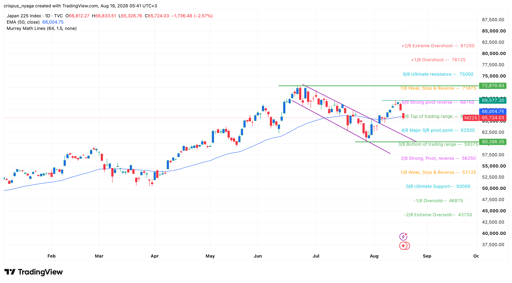
Nikkei 225 Index | Source: TradingView
The daily chart shows that the Nikkei 225 Index has slipped sharply in the past two days. It dropped to 65,724 points, down modestly from this month’s high of 69,577.
It has slumped to the 50-day Exponential Moving Average (EMA) and the top of the trading range level of the Murrey Math Lines tool.
Also, the Relative Strength Index (RSI) has pointed downwards in the past few days.
Therefore, the path of the least resistance is bearish, with the next key target to watch being the Major S/R pivot point at 62,500.

Apple’s foldable iPhone could add $14 billion: why Wall Street still fears a selloff

Hang Seng Index forms a highly bullish pattern as China trade surplus jumps

Samsung, SK Hynix send KOSPI above 7,100 as Nikkei buckles under yen pressure

Michael Burry calls Lululemon his portfolio trickster: why he is buying the crash

Nvidia supplier Wistron is spending big on AI: why is the stock falling?
No results found
Loading articles...
Failed to load articles. Please try again.