
Unitree stock crashes 45% after 460% debut as China’s robot frenzy meets reality
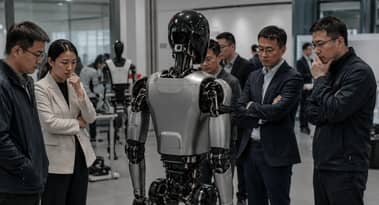
AI Sentiment: 18/100 Bearish
This score is generated through AI-driven analysis of the article's content.

powered by

Sell Unitree into the post-IPO air pocket. The stock is still ~4x the IPO price after a ~45% crash, while profits are already rolling over (adjusted Q1 profit -53%) and management admits humanoids aren’t ready for broad factory use due to efficiency and generalisation limits. The market is repricing from “robot frenzy” to “execution + margins,” and that usually takes more than a week to play out.
Key Risk: Unitree delivers a clear, near-term step-change in unit economics (higher efficiency/lower cost) plus credible follow-on orders that justify the current multiple.
Short the broader “hot IPO” momentum trade in China’s STAR Market/robot names. The article highlights scarcity-driven pricing, limited float, and restricted short-selling—conditions that can create violent reversals when fundamentals wobble. Use this as a theme: when the first high-profile robotics IPO reprices hard, the next wave of retail-driven bids tends to weaken fast.
Key Risk: A new wave of strong earnings guidance and order data across humanoids/embodied AI reignites risk-on buying and squeezes shorts despite the initial repricing.
- Unitree shares are down 45% from their debut high as IPO euphoria fades.
- Profit weakness and limited deployment test Unitree's robotics valuation.
- China's IPO pricing system faces scrutiny after Unitree's violent swing.
Unitree’s stock has gone from the hottest debut in Shanghai to one of the clearest tests of China’s humanoid-robot boom in less than a week.
Shares of the Hangzhou-based company have fallen about 45% from their 1,100 yuan intraday peak on August 19, wiping more than 200 billion yuan from its market value.
The stock closed Monday at 603.08 yuan, down from 845 yuan on its first day, although it still trades at roughly four times the 150.80 yuan IPO price.
The reversal is forcing investors to ask whether Unitree’s valuation ran far ahead of the commercial reality of humanoid robotics.
Valuation raced ahead of the business
Unitree entered the market with unusually strong fundamentals for a humanoid-robot maker.
Revenue jumped more than fourfold to 1.7 billion yuan in 2025 and the company was profitable, while the IPO raised about 6.1 billion yuan.
But the growth profile has become less straightforward. Adjusted first-quarter profit fell about 53% to roughly 40 million yuan as costs rose.
Founder Wang Xingxing also acknowledged at the World Robot Conference that humanoids are not ready for broad factory deployment because they remain less efficient than humans at simple tasks and struggle to generalise across jobs.
That gap between technological promise and commercial use is central to the selloff.
HSBC analysts warned before the listing that the recent surge in humanoid shipments could prove difficult to sustain without meaningful improvements in AI-model capability.
Retail demand turned scarcity into a frenzy
The IPO itself amplified the move. Nearly 9.8 million retail accounts competed for roughly 9.7 million shares in the online tranche.
The stock opened 629% above its issue price and closed its first session 460% higher.
That first-day surge briefly valued Unitree at about 445 billion yuan, or $66 billion. By Monday’s close, its market capitalisation had fallen to roughly 244 billion yuan.
The violent repricing has revived questions about how China prices new listings.
Regulators play a larger role in vetting and pricing IPOs than in many developed markets, while the STAR Market’s limited initial float can create scarcity when demand is extreme.
Restricted short-selling also leaves fewer ways for sceptical investors to push back against an overheated debut.
The result can be a sharp transfer of risk: investors who win IPO allocations benefit from conservative issue prices, while retail buyers entering after the opening surge face much larger downside.
Unitree is now a test for China’s robotics boom
The selloff does not mean China’s robotics strategy has failed. Unitree shipped more than 5,500 humanoids in 2025, making it one of the world’s largest suppliers, and Beijing continues to treat embodied AI as a strategic industry.
Nankai University finance professor Tian Lihui told Xinhua that the sector is moving from technology validation towards commercial-value verification, where profitability becomes the key test.
Nomura analysts remain more constructive, arguing that Unitree’s rapid product development gives it a first-mover advantage.
That is also the lesson from Unitree’s first week as a public company.
Its technology leadership remains intact, but public investors are now putting a price on execution, margins and real-world orders rather than spectacle and policy enthusiasm alone.

Palantir stock may win even if AI boom slows: why Wall Street sees 50% upside

Nikkei 225 Index outlook: Top catalysts for Japan stocks this week

Why Z.ai shares sank over 10% as Chinese OpenAI rival seeks another $5 billion

Kioxia stock is stuck in a bear market: here’s why it may drop further soon

Top reasons why South Korea’s KOSPI Index is falling today (Sept. 14)
No results found
Loading articles...
Failed to load articles. Please try again.