
HYPE price near all-time high: could Hyperliquid's US entry spark $100?

AI Sentiment: 78/100 Bullish
This score is generated through AI-driven analysis of the article's content.

powered by

Buy HYPE. US-access talks via Payward/Bitnomial keep the catalyst alive while the token is already supported by protocol buybacks (fees → HYPE purchases) and short liquidations (most forced sells were shorts). Technicals: bullish Supertrend, CMF positive, and a clean daily close above $85.5 opens $90→$95→$100.
Key Risk: CFTC approval gets delayed or blocked for 10–12+ months, killing the US-entry catalyst while price fails to break and momentum fades.
Sell HYPE perpetuals (or buy puts) into the $85–$85.5 resistance. Stretched 4-hour Stoch RSI near 98 signals crowded upside; if price can’t hold above VWAP (~$84.17) a pullback to $82–$83 is likely, with $79–$80 next.
Key Risk: A decisive breakout holds above $85.5 on strong volume, triggering another wave of short liquidations and forcing shorts to cover higher.
- HYPE has gained more than 4% and is trading near the key $85 resistance.
- US market entry talks are supporting the price move.
- A break above $85.5 could open $90 and $100.
HYPE has gained around 4.5% over the past 24 hours to trade near $84, leaving Hyperliquid just below the $85 to $85.5 resistance area that could determine whether the token can extend its move towards $100.
Hyperliquid Strategies said last week that US President Donald Trump had stated on Aug. 19 that CFTC Chairman Michael Selig was working on bringing Hyperliquid into the United States through a compliant structure.
Fresh reporting on discussions between Hyperliquid Labs and Payward, Kraken’s parent company, has since given traders a clearer idea of how such access could work.
Hyperliquid Labs is reportedly in advanced talks with Payward over offering some Hyperliquid-linked perpetual futures to US traders through Bitnomial, Payward’s CFTC-regulated derivatives exchange and clearinghouse.
Payward has reportedly presented the basic structure to the Commodity Futures Trading Commission, although the plan has not received regulatory approval.
The proposed arrangement would matter because Hyperliquid’s main perpetual futures platform remains unavailable to US users.
Access through Bitnomial could give American traders exposure to Hyperliquid-linked contracts through regulated infrastructure without opening Hyperliquid’s existing decentralised front end directly to the US market.
Payward agreed in April to acquire Bitnomial for up to $550 million. Bitnomial holds the CFTC licences needed to operate a derivatives exchange, clearinghouse and brokerage business, giving Payward an existing regulatory route for offering crypto derivatives in the country.
Regulatory clearance remains a major condition before any launch can take place.
One former SEC counsel cited in the reporting estimated that the process could take another 10 to 12 months, leaving the proposed US entry as a potential catalyst instead of an approved expansion.
HYPE nevertheless reacted strongly as the latest report added detail to an existing US regulatory story.
The token climbed from a close near $80 over the past 24 hours, briefly traded above $85, and later settled near $84. Its 24-hour gain remained above 4% while price stayed close to the upper end of the recent range.
Hyperliquid’s token buybacks have supplied a separate source of HYPE demand.
According to a Financial Times report on Aug. 31, crypto projects had spent nearly $638 million on token repurchases during 2026, with Hyperliquid and Pump.fun responsible for nearly 90% of the total.
Hyperliquid allocates approximately 99% of protocol trading-fee revenue towards HYPE purchases, according to the report.
Roughly $1.3 billion worth of HYPE has been bought back and burned since launch.
Hyperliquid Strategies put the retired amount at around $1.2 billion in recent SEC disclosures, equivalent to approximately 46.4 million HYPE. The figure represented 4.6% of the token’s maximum supply.
Protocol activity has continued to generate the fees that fund those purchases.
Hyperliquid Strategies reported that Hyperliquid held roughly 63% of decentralised perpetual futures open interest as of Aug. 23, with total open interest on the platform reaching approximately $13 billion.
HIP-3 markets accounted for around 48% of Hyperliquid’s trailing 30-day trading volume as of Aug. 23 and had generated more than $514 billion in cumulative volume since launch, according to the same disclosures.
Market deployers also need HYPE as collateral when creating HIP-3 markets, adding another use for the token within the platform.
Derivatives positioning has added pressure to traders betting against the move.
Meanwhile, Coinglass data on Sept. 1 put roughly 85.8% of HYPE liquidations during the previous 24 hours on short positions, meaning short sellers accounted for most forced liquidations as price climbed.
HYPE price analysis
HYPE is trading near $84 after rising from a close to $52 in early August and accelerating sharply once price cleared the $60 area around Aug. 19.
The move reached roughly $85 during the final week of August, but repeated attempts above that area have struggled to hold, leaving $85 to $85.5 as the immediate breakout zone.
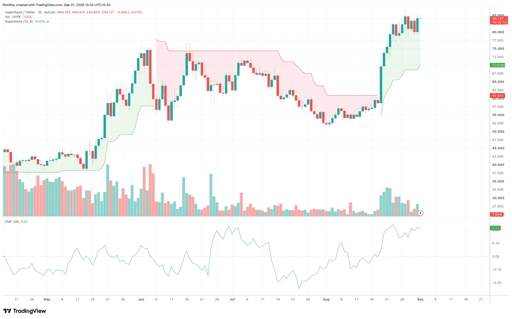
On the daily chart, the Supertrend remains bullish at approximately $70.02.
HYPE/USDT 1 -day price chart. Source: TradingView.
The indicator flipped beneath price during the August breakout and has continued rising while HYPE traded above $80, keeping the main trend positive as long as price stays above the Supertrend line.
Chaikin Money Flow is holding near 0.21, well above zero. CMF climbed as HYPE broke higher and has remained positive while price consolidated around $80 to $85, showing that capital inflows have remained stronger than outflows during the consolidation.
Daily volume expanded sharply as HYPE moved from the $60 area toward $80, then eased as price began moving sideways near the highs.
A daily close above $85.5, especially if volume expands again while CMF stays positive, would clear the most visible resistance from the current structure.
With HYPE already close to its recent highs, $90 would be the first psychological level above a confirmed breakout. Continued buying could then bring $95 into view before the larger $100 target becomes relevant.
Reaching $100 from $85.5 would require another gain of roughly 17%, so the target depends on HYPE first establishing itself above the current resistance zone.
Failure to do so would leave price inside the range that has developed since the final week of August.
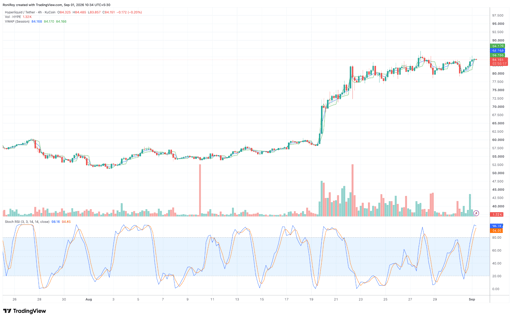
The 4-hour chart puts the immediate pivot almost exactly at the current price. HYPE is trading near $84.15, while session VWAP sits around $84.17.
HYPE/USDT 4-hour price chart. Source: TradingView.
Price has repeatedly moved around VWAP during the latest consolidation, making the $84 area important for short-term direction.
Holding above roughly $84 would keep another attempt at $85 to $85.5 in play. Sustained trading below VWAP could instead pull HYPE towards the lower part of the recent range.
The 4-hour Stochastic RSI has climbed to approximately 98.16, with its signal line near 94.85.
Both readings are well above the 80 level after rising quickly from oversold territory, showing that short-term momentum has become heavily stretched as HYPE approaches resistance.
A bearish Stochastic RSI crossover while price remains below $85.5 would increase the chance of a pullback towards $82 to $83.
Failure to hold that zone could expose $79 to $80, an area where buyers repeatedly stepped in during the final week of August.
The daily Supertrend near $70 sits much lower than those short-term supports, so a move back towards $80 would not by itself break the larger bullish structure.
A deeper loss of $79 to $80 could open $75, while a daily break below the Supertrend around $70 would invalidate the current bullish trend signal.

Strategy (MSTR) stock gains after resuming Bitcoin purchases after 10 weeks

Ethereum price holds near $2,450 despite Fed pressure: Is $2,500 next?

Why is Bitcoin price down today?

PURR stock price forecast as Hyperliquid’s HYPE token hits a record high

Bitcoin ETFs keep buying, so why is BTC still stuck below $80K?
No results found
Loading articles...
Failed to load articles. Please try again.