
Xiaomi-Aktienanalyse: Warum das „Apple Chinas“ im freien Fall ist

KI-Sentiment: 12/100 Bärisch
Diese Bewertung wird durch eine KI-gestützte Analyse des Artikelinhalts erzeugt.

Unterstützt von

Kaufempfehlung für Micron (MU). Die Nachrichten deuten auf einen echten, anhaltenden Memory-Upcycle hin, der Preise und Nachfrage entlang der gesamten Lieferkette hebt; Xiaomi kann keine Speicher herstellen, daher ist dies eine Belastung im Downstream, nicht ein Kollaps der Nachfrage. Bleiben Memory-Preise erhöht, verbessert sich MUs Ertragskraft, selbst wenn einige Handyhersteller Auslieferungen kürzen.
Kernrisiko: Die Memory-Preise drehen schnell nach unten (oder Kunden stoppen Einkäufe), wodurch MUs Preise und Margen stark unter Druck geraten.
Verkauf/Short-Position auf Xiaomi. Die These: Margendruck durch höhere Memory-Kosten (Xiaomi bezieht DRAM/NAND von SK Hynix/Micron/Samsung) plus eine Abschwächung der Smartphone-Nachfrage (shipments down to 33.8m, revenue -10.9%, profit -56.5%). Die technischen Indikatoren bestätigen die Momentum-Situation: unter dem 50-week EMA, Durchbruch der Dreifach-Top-Nackenlinie (≈H$36) und ein schwacher RSI – daher dürfte der Abwärtstrend voraussichtlich bis zur Unterstützung bei rund ~$19.86 fortgesetzt werden.
Kernrisiko: Ein starker Nachfrageaufschwung bei Smartphones oder eine schnelle Umkehr der Memory-Preise, die die Margen schneller wiederherstellt als vom Markt erwartet.
- Die Xiaomi-Aktie befindet sich in diesem Jahr in einem starken freien Fall.
- Dabei hat sie während dieses Rückzugs über $118 billion an Marktwert eingebüßt.
- Das Unternehmen sieht sich dem Risiko stark steigender Speicherpreise gegenüber.
Xiaomi stock price has suffered a major reversal in the last 12 months, moving from a high of H$61.55 to H$22.62 today, its lowest level since September 2024, with its market cap falling from H$1.53 trillion ($192 billion) to $74 billion. This retreat has happened amid the soaring memory prices and the ongoing retreat in EV stocks.
Xiaomi-Aktie im Rückzug vor dem anhaltenden Preisanstieg bei Speicherchips
Xiaomi, a company often compared with Apple, has dropped sharply this year, and is now hovering at its lowest level since 2024. This retreat has made it one of the worst-performing companies in the Hang Seng Index.
The company is facing some major challenges that are affecting its profits. The most notable one is the ongoing semiconductor and memory price surge around the world.
This is important because the company does not manufacture its own memory products. Instead, it uses products made by companies like SK Hynix, Micron, and Samsung Electronics. These companies have all seen a surge in memory demand, which has pushed their prices higher.
As a result, smartphone manufacturers are working on boosting their prices, which may affect their demand. Just last week, Apple became the first major company to say that it will hike prices for the next iPhones.
Xiaomi has also struggled because of its electric vehicle business. While its EV sales are rising, there are concerns that demand will wane after Beijing ended its subsidies earlier this year. All EV stocks have plunged sharply this year.
The most recent results showed that Xiaomi’s business is going in reverse gear. Its revenue dropped by 10.9% to H$99.14 billion in the first quarter from the previous year’s H$111.2 billion.
Its profitability metrics were worse. Its profit for the period declined by 56.5% to H$4.7 billion, while the operating profit fell by 60% to H$5.3 billion. These declines were mostly driven by the smartphone segment whose shipments dropped to 33.8 million units from 41.8 million in the same period last year.
READ MORE: Apple, Samsung warn of memory shortage in results: these stocks will benefit
The same slowdown is happening across its other segments. Vehicle deliveries dropped to 80,856 from 145,115 in the fourth quarter. Q4’s surge happened as customers rushed to buy ahead of the expiration of subsidies.
With its business slowing, the company has moved to financial engineering by reducing the number of outstanding shares. It bought 250 million shares valued at over H$8.4 billion.
Technische Analyse der Xiaomi-Aktie
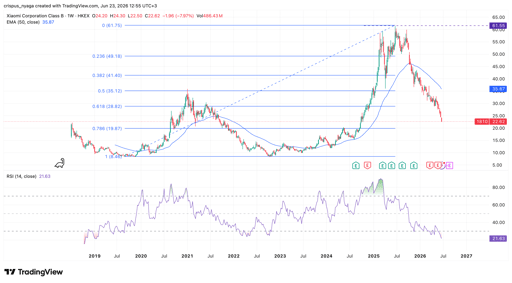
Xiaomi stock price chart | Source: TradingView
The weekly chart shows that the Xiaomi share price has slumped in the past few months. This retreat happened after the stock formed a triple-top pattern at H$61.5 and a neckline at H$36. It has slumped below the 50-week Exponential Moving Average (EMA).
The stock has dropped below the 61.8% Fibonacci Retracement level, while the Relative Strength Index (RSI) moving below the oversold level. Therefore, the stock will likely continue falling, potentially to the key support of $19.86, the 78.2% retracement level.

Warum die SpaceX-Aktie am Freitag um rund 1% steigt

Sollten Sie den Rücksetzer bei OKLO-Aktien heute kaufen?

Analyst: Adobes Rückgang nach Zahlen liegt nicht nur an KI‑Ängsten

Dow steigt um 500 Punkte nach vier Tagen Verlust — Ölpreise ziehen sich zurück

Darum befindet sich die Enbridge-Aktie in einem starken Abwärtstrend
Keine Ergebnisse gefunden
Artikel werden geladen...
Failed to load articles. Please try again.